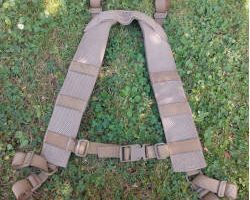
Suspenders, Individual Equipment, H-Type, Khaki
Australian M-1988 ICLCE H-Type khaki web suspenders, developed from the final M-1956 (Aust) design and used to support the ammunition pouches and field pack.
Australia

Australian M-1988 ICLCE H-Type khaki web suspenders, developed from the final M-1956 (Aust) design and used to support the ammunition pouches and field pack.
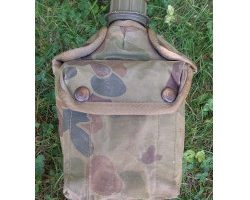
Developed for the Australian M-1988 Individual Combat Load Carrying Equipment (ICLCE), the Cover, Water Bottle evolved from the final M-1956 design. Later examples incorporated a front pouch to carry a Hexi Cooker and fuel tablets, combining water, cup and cooking equipment into a single pouch.
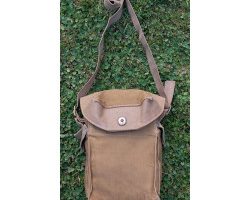
The Australian Haversack, Respirator, Anti-Gas, Light was a waterproofed canvas carrier developed for use with the Respirator, Anti-Gas, Light during the Second World War. Based on the British design but modified for tropical conditions, it incorporated a Lift-The-Dot closure, triglide strap fittings, and compartments for respirator accessories and anti-gas equipment.
The M-1988 Individual Combat Load Carrying Equipment (ICLCE) marked Australia’s transition toward synthetic webbing, combining nylon components with woven cotton pouches designed to swell and improve water resistance when wet. Developed from lessons learned with the M-1956, it improved durability, ergonomics, and adaptability for modern combat operations.
Read More »
The Australian M-1956 Load Bearing Equipment was an adaptation of the U.S. M1956 system, modified to suit local operational needs and environments. Combining American design with Australian experience, it provided improved load-carrying capacity and durability for combat operations from the late 1950s through to the 1980s.
Read More »

Australia’s vast arid and semi-arid regions presented a persistent challenge to military operations, particularly in relation to water supply. Carrying sufficient water over long distances was difficult, and reliance on vehicle resupply was not always practical in remote or undeveloped areas. As a result, Australian forces explored methods of increasing the amount of water carried by individual soldiers without resorting to large, rigid containers or constant resupply.
Read More »

The frill-neck hat forms part of a broader family of headwear sometimes referred to as the “Urban Turban” style, produced in Australia by Frillneck. The design takes its name from the frill-neck lizard native to Australia, a reference that reflects both its appearance and its intended function in extreme heat environments.

During the Malayan Campaign of the early 1960s, Special Air Service (SAS) patrols operated deep in the jungle for weeks or even months at a time. They required low-mounted utility pouches to carry Escape and Evasion (E&E) equipment—pouches that could ride beneath the bergen’s A-frame and hold enough survival gear to allow a trooper to operate without a full field pack until reaching friendly lines or extraction.

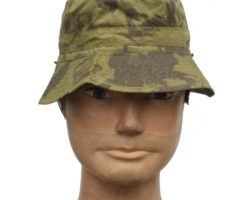
The Hat, Utility, Camouflage, Waterproof was first issued in the mid-1960s, alongside a waterproof smock made in the same camouflage pattern. Designed for use in humid jungle environments, the hat was issued in more limited numbers than the smock.
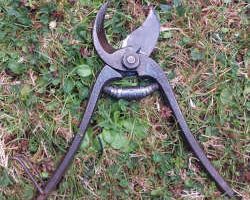
Secateurs—a hand tool more commonly found in the garden shed and often wielded by old ladies trimming rose bushes—are not something most people associate with soldiers. Yet, these heavy-duty shears, designed for cutting and pruning bushes and small trees, found their way into the kit of Australian and New Zealand troops operating in dense jungle environments.
Read More »