
Hat, Frillneck, DPDU
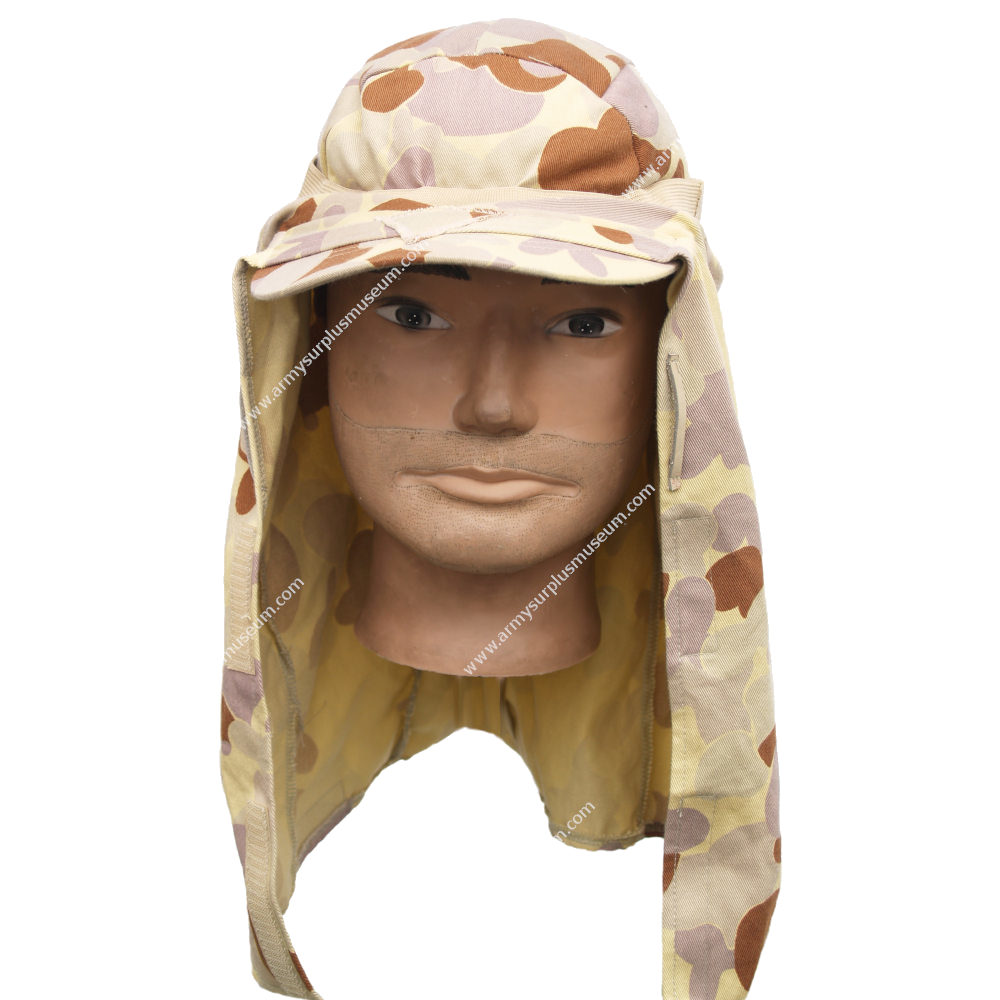
General Information
Name: Hat, Frillneck, DPDU 1.
Country of Origin: Australia.
Date of Production: c 2010.
Manufacturer: Frillneck.
NATO Stock Number (NSN): Yet to be identified.
Contract Number: Yet to be identified.
Camouflage Pattern: Disruptive Pattern Desert Uniform (DPDU).
Uniform Family: Disruptive Pattern Desert Uniform (DPDU).
Size: One size fits all (OSFA).
Weight: 250gms.
Windproof: Yes.
Waterproof: No.
History
The frill-neck hat forms part of a broader family of headwear sometimes referred to as the “Urban Turban” style, produced in Australia by Frillneck. The design takes its name from the frill-neck lizard native to Australia, a reference that reflects both its appearance and its intended function in extreme heat environments. The hat was produced in both Disruptive Pattern Desert Uniform (DPDU) and Disruptive Pattern Combat Uniform (DPCU) camouflage patterns and first appears to have entered service in the early 2000s.
The Frillneck hat is a distinctive hybrid design, combining elements of a shemagh-style neck drape with a peaked cap, and shares conceptual similarities with an Australian-issued kepi-style cap. Unlike traditional desert scarves or soft head coverings, the frill-neck configuration integrates sun protection directly into a structured cap, providing coverage to the neck and sides of the face while remaining stable during movement.
This style of headwear appears to represent a uniquely Australian response to prolonged exposure in hot, arid conditions, where conventional caps offered insufficient protection and full head wraps were impractical for routine wear. The frill-neck hat can often be seen worn by Australian personnel operating in Iraq and Afghanistan during the Global War on Terrorism (GWOT).
Following Australia’s adoption of the Australian Multicam Camouflage Uniform (AMCU) in 2014, the Frillneck hat saw declining use and no longer seems to be worn in service.
Description
The hat is fabricated from cloth woven in a 75% cotton and 25% nylon blend. The crown is constructed from six panels of DPDU cloth, with four inner panels forming the main body of the crown. The forehead is made from a dedicated cloth panel to which the remaining panels are sewn. The side panels join over the top of the brim at the forehead, with the seam junction concealed beneath a diamond-shaped cloth patch. Internally, the forehead section is lined with olive green polyester sweat-absorbing fabric.
The side panels are folded in a concertina fashion and measure approximately 36 cm in length. Sewn across the forehead, between the front panels and the brim, is a strip of heavy-duty elastic. Attached to the sides of this elastic, positioned above the ears, are 4.5 cm lengths of 25 mm hook-and-loop fastening tape. At the rear of the head, the elastic strap is adjustable by means of a 10 cm length of hook-and-loop fastening tape, with a lightweight elastic loop sewn centrally into the lower edge of the fastening. The forward hems of the side panels incorporate a 6 cm loop of thin leather along with corresponding hook-and-loop fastening tape strips.
The brim is sewn to the front of the crown and is faced with DPDU cloth on the upper surface and tan fabric on the underside, with a plastic interlining for stiffness. Two semi-circular lines of stitching run around the mid-section of the brim.
Examples
Example One
Example one is a later-issued version produced in the Series 3 Disruptive Pattern Desert Uniform (DPDU) camouflage pattern.
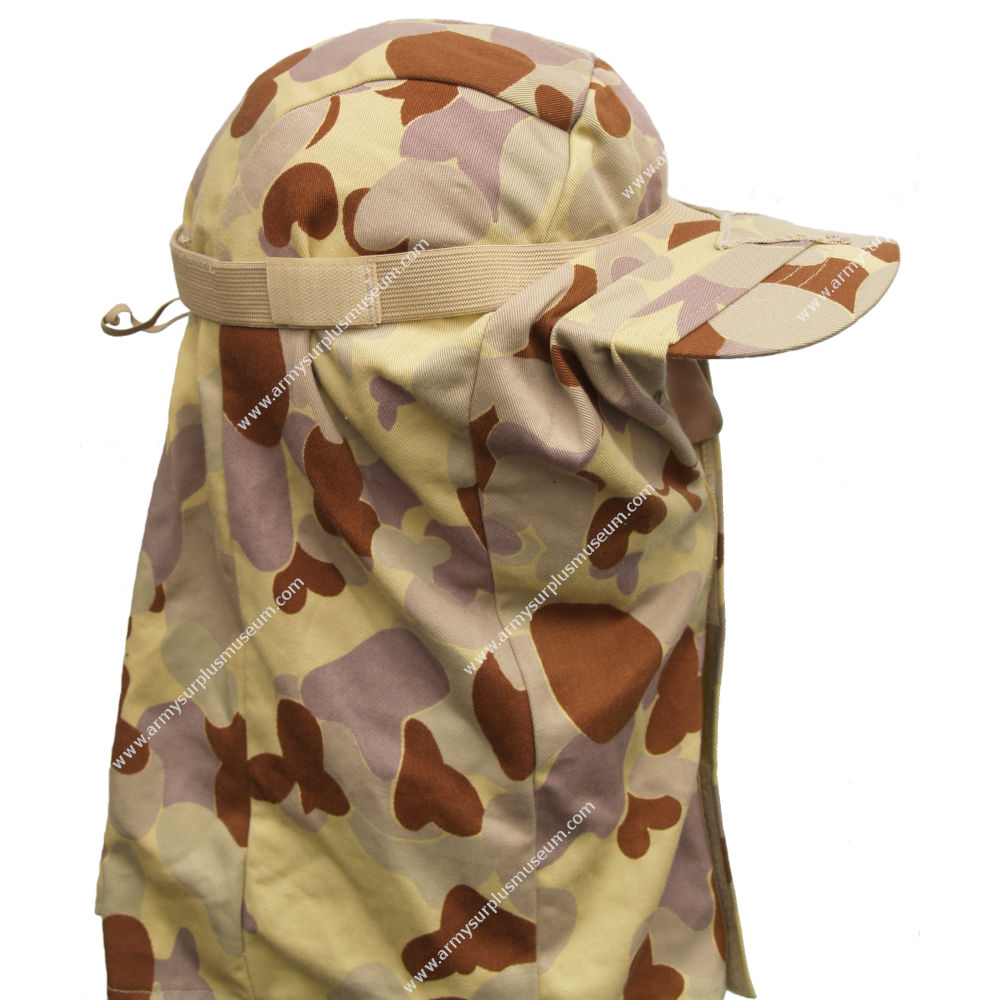
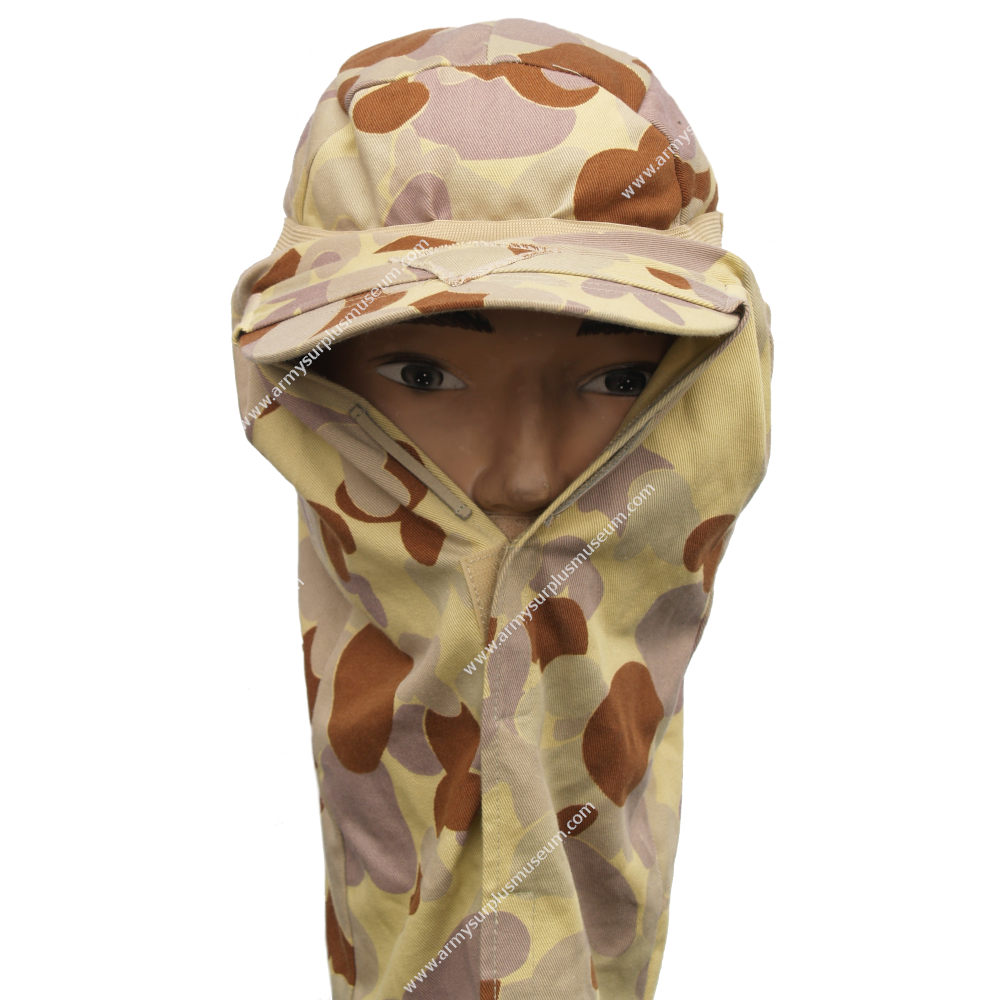
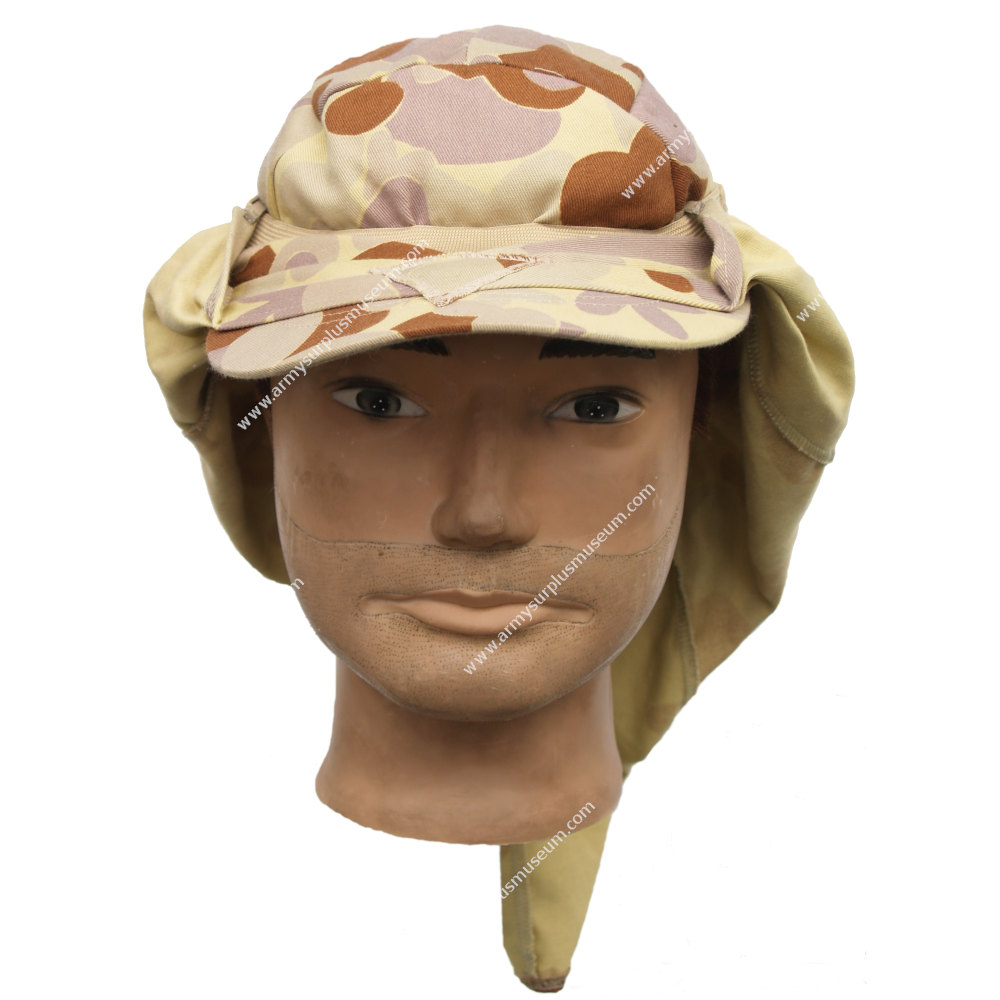
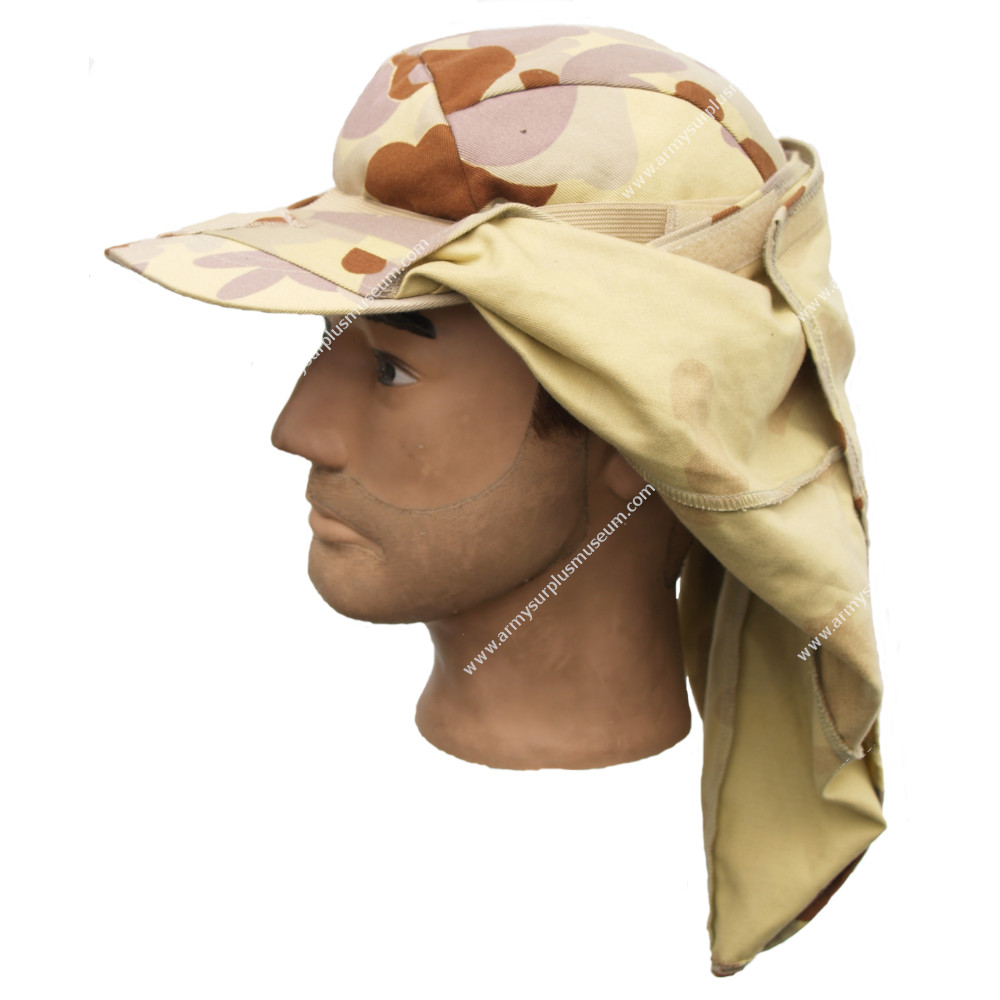
Object Number: 8715-360-37103.
1 Note 1: This is just a generic name, as we have yet to find its actual name.
