
Harness, Water, 5L, Canvas (Skeleton-Type)

General Information
Name: Harness, Water, 5L, Canvas (Skeleton-Type) 1.
Country of Origin: Australia.
Date of Production: 1963.
Manufacturer: Commonwealth Government Clothing Factory (CGCF).
Stores Number: Yet to be identified.
Colour: Khaki.
Equipment Family: Yet to be identified.
Size: One size fits all (OSFA).
Number Of compartments:2.
Volume Capacity: 5L.
Weight:: 1kg.
History
At present, relatively little is known about this object and surviving documentation is limited. The following interpretation has therefore been assembled from physical examination, comparative examples, and known Australian military practices of the Second World War and the immediate post-war period.
Australia’s vast arid and semi-arid regions presented a persistent challenge to military operations, particularly in relation to water supply. Carrying sufficient water over long distances was difficult, and reliance on vehicle resupply was not always practical in remote or undeveloped areas. As a result, Australian forces explored methods of increasing the amount of water carried by individual soldiers without resorting to large, rigid containers or constant resupply.
This water harness appears to have been conceived as a response to that problem, allowing a soldier to carry approximately five litres of additional water on the body. The harness was likely intended to be worn over the web equipment and beneath a rucksack. In practice, however, it may more commonly have been carried strapped externally to the rucksack, functioning in much the same manner as saddle bags.
To prepare the water carrier for use, it was necessary to soak it in water for 24–48 hours, allowing the canvas fibres to absorb moisture and swell. This process did not make the carrier waterproof, but it significantly reduced leakage. Controlled seepage allowed the water to evaporate slowly through the canvas, providing effective evaporative cooling and helping to keep the contents cool even in desert conditions.
Although the service history of this object is not fully documented, its design strongly suggests influence from traditional saddle bag and pannier systems, combined with the concept of the Australian flax canvas water bag (closely related in function to the British-issued Chagul). Adapted for human carriage, the paired containers joined by a central yoke mirror long-established methods of balancing loads on animals and vehicles. This effectively translates saddle-mounted load distribution into a body-worn format.
In addition, the strap arrangement shows similarities to Commonwealth webbing practice, particularly elements seen in Pattern 1937 utility pouches, indicating that existing web equipment design principles were adapted to support this specialist role. Together, these influences suggest a pragmatic attempt to move the concept of saddle bags from animal and vehicle carriage to the individual soldier, creating a body-mounted, task-specific water-carrying system.
It is not presently possible to confirm whether this water harness saw service during the Second World War, the Korean War, the Malayan Emergency, or the Vietnam War. However, given its design and intended purpose , it would not be surprising if similar systems were employed during conflicts such as the Malayan Emergency and the early years of the Vietnam War, where access to reliable fresh water was frequently a limiting factor. It is most likely that this type of water carrier was withdrawn from Australian service with the adoption of the two litre vinyl bladder and cover in the late 1960s, reflecting a broader shift toward lighter, sealed, and more standardized hydration systems.
Description
The base of the harness is fabricated from woven cotton canvas and is fitted with a heavy-duty green vinyl backing, likely intended to protect the wearer’s clothing from moisture transfer. The neck section measures approximately 31 cm in length and 7 cm in width at the centre, tapering to approximately 17.5 cm at its widest outer points.
The water bladders are constructed from woven flax canvas and are sewn to the harness separately along each side, leaving a visible gap between the bladder bodies and the harness base. This separation suggests a modular construction, allowing the harness and bladders to function as distinct components. Each bladder measures approximately 39 cm in length and 10 cm in width.
Each bladder is fitted with a fixed Bakelite bung and a flat screw-on cap, retained by a metal chain tether secured to the internal centre of the bung. This arrangement would reduce the likelihood of cap loss during use.
Sewn to the right-hand panel, on both sides of the harness, is a metal Pattern 1937–style ladder-lock buckle. Sewn to the left-hand panel, on each side, is a brass D-ring, to which are attached two woven webbing straps: one longer rear strap and one shorter front strap. These straps are of the same style and construction as those used in Pattern 1937 Web Equipment, indicating the reuse of established Commonwealth webbing components.
Examples
Example One
Example One is missing the screw cap on the right-hand bladder. This loss has been observed on other surviving examples, suggesting that cap retention, despite the chain tether, may have been a common failure point during service use.
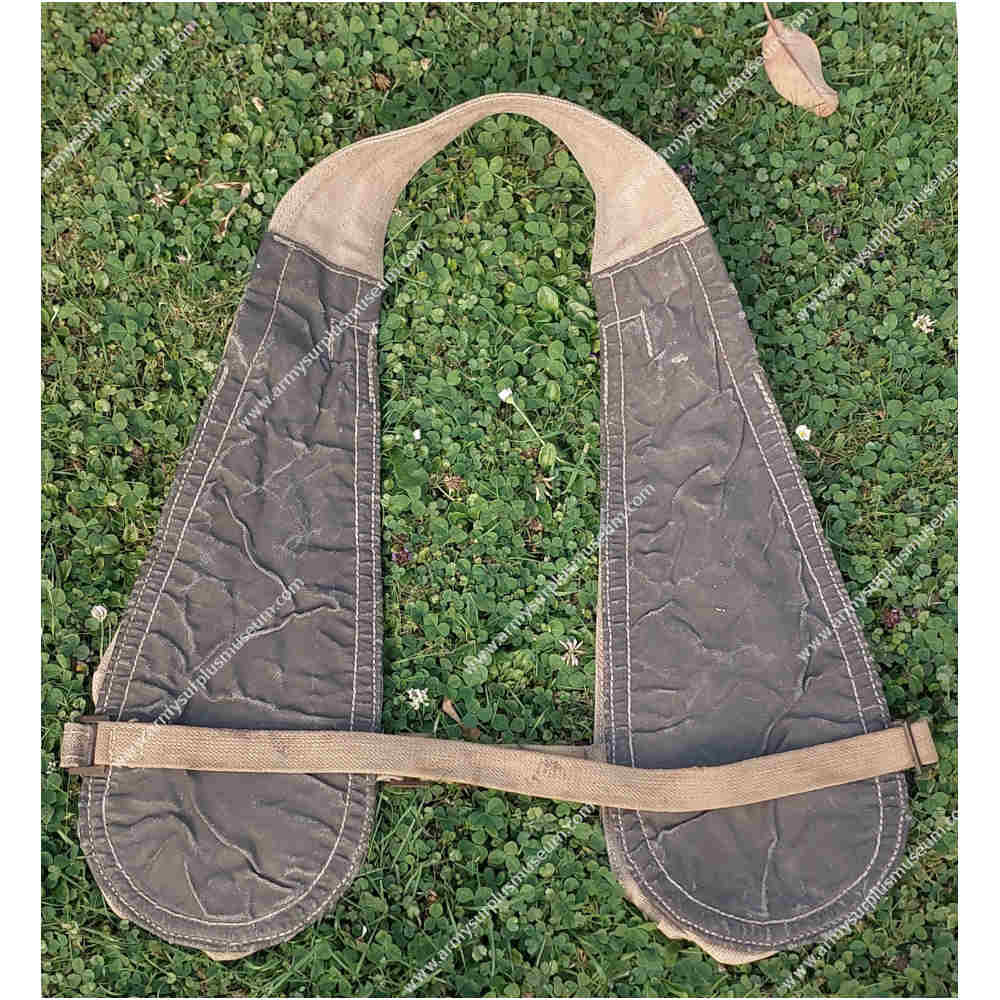

Object Number: 2428-360-46100.
1 Note 1: This is just a generic name, as we have yet to find its actual name.
