
M-1956 Load Bearing Equipment (Aust)
Lineage:
Overview:
In the late 1950s, following the adoption of the L1A1 Self-Loading Rifle, Australia began searching for a replacement for its aging Pattern 1937 and Pattern 1944 web equipment systems. After a series of trials, the U.S. M1956 Load-Carrying Equipment was selected as the most suitable interim solution.
While the American design performed well in training and general field use within Australia, its limitations became clear during deployment to Vietnam. The M1956 system was built around the assumption of daily resupply, whereas Australian patrols routinely operated for extended periods in remote jungle environments with little or no logistical support. Soldiers found the M1956 incapable of carrying sufficient ammunition, rations, or personal gear for multi-day operations.
To compensate, the Army reissued components of the Pattern 37 and Pattern 44 sets alongside the M1956 until a dedicated Australian system could be developed. This new design would need to accommodate larger ammunition loads, standardized field packs, and the ability to be scaled up or down depending on mission requirements.
Design and Construction:
With the need for a new web equipment system becoming urgent, Australia did what it often does best—reinvented what already worked. Engineers combined elements from the U.S. M1956 with proven features from the earlier British webbing patterns.
The new Improved M1956 Web Equipment was fabricated from cotton-and-nylon blended duck fabric, which offered greater strength and faster drying than pure cotton while remaining quiet and comfortable to wear.
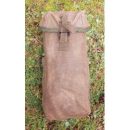
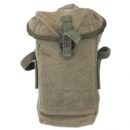
- Ammunition Pouches: Enlarged to hold additional 7.62 mm SLR magazines, with stronger stitching and improved closure lids.
- Canteen Carrier: Adopted the belt-attachment system from the Pattern 44 water-bottle carrier, allowing multiple canteens to be positioned along the rear of the belt beneath the field pack.
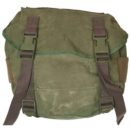
- Field Pack: Standardized so that all soldiers carried the same type of load—replacing the mixture of Pattern 37 large packs and lightweight tropical rucksacks seen earlier.
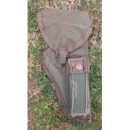
- Additional Components: Included a redesigned pistol holster, a dedicated pouch for the Hootchie/Basha/Shelter Individual, and a larger two litre canteen for extended patrols.
The overall layout remained modular, allowing troops to tailor their configuration based on operational needs while retaining interchangeability between components.
Service Use:
The Improved Australian M1956 Web Equipment was well received and quickly became the standard load-bearing system for combat troops. It successfully addressed the major shortcomings encountered in Vietnam, offering greater carrying capacity and more balanced weight distribution.
The system remained in service through the late 1970s and into the early 1980s, seeing incremental refinements but few fundamental design changes. By the end of its service life, the Army had begun experimenting with new improvements for the first time since its introduction in 1968.
Officers’ Equipment:
Unlike earlier Commonwealth systems, the U.S. M1956 Load-Carrying Equipment did not include a distinct officer’s configuration, and Australia carried this principle forward. It was issued as a universal set, adaptable to any rank or role through interchangeable components. Officers, NCOs, and enlisted soldiers drew the same webbing from unit stores and configured it to suit personal and operational needs.
This approach reflected Australia’s post-war emphasis on practicality and shared responsibility in combat. Specialist pouches such as the compass case, binocular case, and pistol holster were issued only when their associated equipment was required, marking the end of rank-specific load-carrying systems.
International Use:
Unlike the 37 and 44 Patterns, the Australian M1956 never saw export or licensed foreign manufacture. It was uniquely tailored to local operational demands and environmental extremes—from monsoonal jungle to desert scrub—and thus remained a strictly national system.
Its influence, however, was indirect: New Zealand evaluated several components for potential issue, and Australian-style field modifications appeared among regional Commonwealth forces operating alongside ANZAC units in Vietnam. Elements of its construction—particularly the six-ounce core-spun duck fabric and simplified attachment fittings—anticipated later Commonwealth experiments in hybrid webbing materials.
Technical Evaluation:
The Improved M1956 represented a decisive Australian step away from inherited British practice. It combined the modular efficiency of the U.S. design with rugged, humidity-tolerant textiles and practical field feedback.
Testing in 1966–68 demonstrated that core-spun duck retained its structural integrity under both tropical and arid stress, outlasting pure cotton while avoiding the heat deformation common in early nylon gear. The standardized field pack improved unit cohesion and reduced logistic complexity, while enlarged ammunition pouches and the adoption of plastic water canteens directly addressed endurance issues exposed in Vietnam.
By contemporary standards, it remained heavy when wet, but its quiet fabric, simple fittings, and ease of repair made it a favourite among seasoned troops.
Summary:
The Australian Improved M1956 Load-Carrying Equipment bridged the gap between British tradition and modern, mission-tailored design. It was an adaptive, soldier-driven evolution that defined Australia’s independent approach to combat gear for two decades.
Although ultimately superseded by the M1988 Individual Combat Load-Carrying Equipment (ICLCE), the Improved M1956 set the pattern—literally—for future systems: robust canvas construction, scalable layouts, and an emphasis on practicality over uniformity. It remains a milestone in Australia’s shift from Commonwealth standardization to national innovation in field equipment.
Although the system remained serviceable well into the 1980s, its canvas-and-metal construction was increasingly viewed as outdated. In a final attempt to extend its relevance, the Improved M1956 was even produced in Disruptive Pattern Camouflage Uniform (DPCU) fabric during the mid-1980s. This brief experiment was likely intended to test camouflage compatibility and prove the design’s obsolescence before transitioning to a fully synthetic successor.
That successor arrived with the M1988 Individual Combat Load-Carrying Equipment (ICLCE)—a system that retained the familiar layout of the M1956 but modernized every element for the new era of synthetic materials, plastic fittings, and Australian-specific weapon systems.
Australian M-1956 Web Equipment Objects:
Click here to view the full list of objects attached to this tag.
Lineage:
