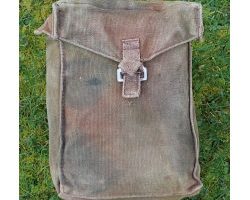
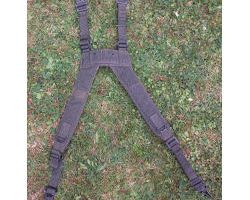
Pouches, Ammunition, Basic (Pair)
The most that can be ascertained at present is that these pouches are likely commercial variants of the Malaysian Army M-1970 Pouches, Ammunition, produced locally in Malaysia during the late 1970s.
Malaysia
Home » Field Equipment » Web equipment » Page 2
The most that can be ascertained at present is that these pouches are likely commercial variants of the Malaysian Army M-1970 Pouches, Ammunition, produced locally in Malaysia during the late 1970s.
The Israeli binocular case appears to use the British Pattern 1937 Web Equipment binocular case as a design base and was intended for use with the Israeli Defence Forces Tziyud Ḥagur (Load-Bearing Equipment) web system. This system combined design elements derived from British Pattern 1937 and U.S. M-1936 web equipment, alongside locally developed Israeli solutions, and was in use during the 1960s and 1970s.
Read More »
Australia’s vast arid and semi-arid regions presented a persistent challenge to military operations, particularly in relation to water supply. Carrying sufficient water over long distances was difficult, and reliance on vehicle resupply was not always practical in remote or undeveloped areas. As a result, Australian forces explored methods of increasing the amount of water carried by individual soldiers without resorting to large, rigid containers or constant resupply.
Read More »
When Malaysia chose to issue a close copy of the U.S. M-1961 Field Pack, Combat alongside their M-1970 web equipment, by the late 1980s commercial companies began producing variants of the standard components in nylon duck printed with the M-1970 brushstroke camouflage pattern. The Field Pack, Combat was one of the items offered in this commercial line.
The Pouch, Canvas, Utility was fabricated from heavy cotton canvas and appears to have been influenced by the British SAS Pouch, Ration, Escape. Its design suggests post-war adaptation or local manufacture inspired by British special forces equipment used during jungle operations in Southeast Asia.
During the Malayan Campaign of the early 1960s, Special Air Service (SAS) patrols operated deep in the jungle for weeks or even months at a time. They required low-mounted utility pouches to carry Escape and Evasion (E&E) equipment—pouches that could ride beneath the bergen’s A-frame and hold enough survival gear to allow a trooper to operate without a full field pack until reaching friendly lines or extraction.
In the late 1970s, Singapore began developing a new web equipment system to replace its earlier cotton-based sets with more modern materials. This system was designed not only to carry the standard water bottle but also to accommodate a Mills-type water filter bank and water sterilization tablets, reflecting the growing emphasis on field hygiene and modular utility.
Read More »
In early 1942, Australia recognized the need to redesign the Pattern 37 web equipment based on combat experience in the Pacific against Japanese forces. The standard Basic Pouches were found to be too small to carry sufficient amounts of ammunition and munitions for the challenging conditions of jungle warfare.
Read More »
In 1970, Malaysia adopted a brushstroke camouflage pattern for its military uniforms and equipment. This decision led to the exclusive production of field packs in this distinct design. Naturally, commercial manufacturers followed suit, producing webbing and accessories in the same pattern to meet market demands.
Read More »
With New Zealand severing ties with the United States and Australia over its decision to become nuclear-free in the mid-1980s, it faced challenges in sourcing individual equipment to replace stock that was needed but no longer accessible through usual channels.
Read More »
© 2026 The Army Surplus Museum