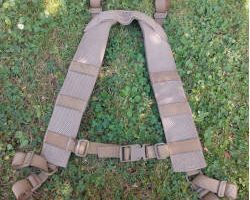
Suspenders, Individual Equipment, H-Type, Khaki
Australian M-1988 ICLCE H-Type khaki web suspenders, developed from the final M-1956 (Aust) design and used to support the ammunition pouches and field pack.
Australia

Australian M-1988 ICLCE H-Type khaki web suspenders, developed from the final M-1956 (Aust) design and used to support the ammunition pouches and field pack.
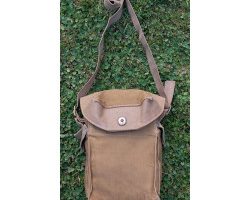
The Australian Haversack, Respirator, Anti-Gas, Light was a waterproofed canvas carrier developed for use with the Respirator, Anti-Gas, Light during the Second World War. Based on the British design but modified for tropical conditions, it incorporated a Lift-The-Dot closure, triglide strap fittings, and compartments for respirator accessories and anti-gas equipment.
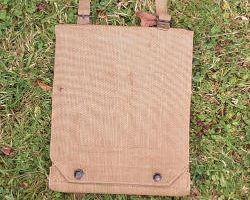
By the early 1940s, the original Case, Map, G.S. No. 2 Mk. 1 was redesigned under wartime production pressures. The revised Mk. 1/1 (Emergency or Economy Pattern) eliminated the rigid plywood backing, reducing both material use and manufacturing complexity.
Read More »

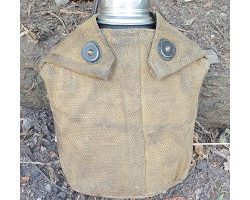
At first this cover was believed to be an early Singaporean canteen cover dating from the early to late 1970s. However, further research suggests it is more likely of Malaysian origin, either issued by the Malaysian Army in the late 1960s or produced commercially in Malaysia during the 1970s.

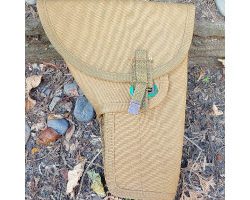
The Holster, C, No.2, Mk II was designed to carry the Inglis 9 mm Browning Hi-Power pistol, along with a cleaning rod and spare magazine. It was developed and produced by Canada in the closing years of the Second World War in response to shortcomings identified in the earlier Holster, C, No.1, Mk I—a Chinese-designed holster pattern originally produced for Chinese forces.


The Israeli binocular case appears to use the British Pattern 1937 Web Equipment binocular case as a design base and was intended for use with the Israeli Defence Forces Tziyud Ḥagur (Load-Bearing Equipment) web system. This system combined design elements derived from British Pattern 1937 and U.S. M-1936 web equipment, alongside locally developed Israeli solutions, and was in use during the 1960s and 1970s.
Read More »


Australia’s vast arid and semi-arid regions presented a persistent challenge to military operations, particularly in relation to water supply. Carrying sufficient water over long distances was difficult, and reliance on vehicle resupply was not always practical in remote or undeveloped areas. As a result, Australian forces explored methods of increasing the amount of water carried by individual soldiers without resorting to large, rigid containers or constant resupply.
Read More »
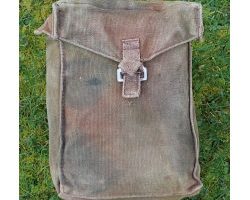
The Pouch, Canvas, Utility was fabricated from heavy cotton canvas and appears to have been influenced by the British SAS Pouch, Ration, Escape. Its design suggests post-war adaptation or local manufacture inspired by British special forces equipment used during jungle operations in Southeast Asia.
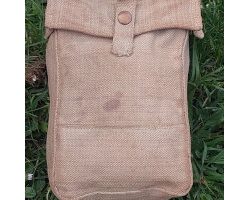
In early 1942, Australia recognized the need to redesign the Pattern 37 web equipment based on combat experience in the Pacific against Japanese forces. The standard Basic Pouches were found to be too small to carry sufficient amounts of ammunition and munitions for the challenging conditions of jungle warfare.
Read More »
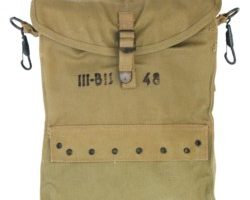
The Bag, Canvas, Medical was issued to US medics during the mid to later stages of World War Two. It was designed to hold a large amount of medical supplies and featured two types of attachment panels: one for medical instruments and the other for vials of pills, lotions, and powders. Eventually, the Bag was replaced in the U.S. inventory by the Case, Non-rigid, No. 3 (M-3 Aid Bag).
Read More »