
Pattern 44 Web Equipment
Overview:
The Pattern 1944 Web Equipment was introduced near the end of the Second World War as a direct evolution of the 1937 Pattern. Experience in Burma and the Pacific had shown that the earlier cotton webbing absorbed water, rotted quickly, and became unbearably heavy in tropical climates. The 44 Pattern was designed to solve those issues through lighter construction, darker camouflage shades, and fittings suited to jungle and mechanized operations.
Although finalized too late for broad wartime issue, the system marked a decisive shift in British design philosophy—from parade-grade durability to practical, climate-tuned field performance.
Design and Construction:
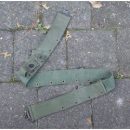
The 44 Pattern was fabricated from tightly woven cotton webbing using finer yarn to reduce weight and improve drying speed. The fabric was rot- and mildew-treated, dyed in jungle-green or olive-drab tones, and fitted with anodized alloy hardware in place of brass to prevent corrosion and glare.
The familiar belt-and-brace arrangement remained but with wider, bifurcated shoulder braces providing six load-bearing points for improved comfort. Components such as the pouches, pack, and water-bottle carrier were simplified with quick-release tabs and strong cotton stitching for reliability. Issued with the web set was a small haversack, with a larger rucksack available for extended use. When required, the rucksack could be attached to the Manpack carrier.
Service Use:
Because production began in 1945, the 44 Pattern saw only limited wartime issue—primarily to airborne and Far East formations. Wider use followed through the late 1940s and 1950s across Southeast Asia, the Middle East, and Africa, where its lighter, quick-drying webbing proved invaluable. It became standard during the Malayan Emergency, and troops frequently modified sets for local conditions.
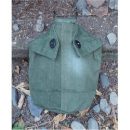
New Zealand forces retained 44 Pattern components well into the Vietnam era and beyond, while the Gurkhas continued to use complete sets until the late 1990s during their final postings in Hong Kong—the last British unit to do so. The water-bottle and carrier, in particular, earned a reputation for durability and practicality. So effective were they that the Royal Marines’ Mountain and Arctic Warfare Cadre later reissued the design in the 1980s, favouring its simplicity and reliability over the newer 58 Pattern plastic equivalent in freezing conditions.
While the Pattern 44 did not directly evolve into the later Pattern 58 Web Equipment, it embodied the lessons learned from tropical warfare and influenced the shift toward entirely new design philosophies in post-war load-carrying systems. However, the Pattern 44 set did not disappear entirely—its water-bottle and carrier were widely regarded as superior to those of the Pattern 58. In the mid-1980s, the Royal Marines’ Mountain and Arctic Warfare Cadre revived and reissued the Pattern 44-style water-bottle and carrier for use in Arctic conditions, where its proven simplicity and reliability once again made it the preferred choice.
Officers’ Equipment:
The Pattern 1944 Web Equipment continued the principle first introduced with the 1937 Pattern, in which officers were issued web equipment configured specifically for their duties.
Building upon that precedent, it included a defined configuration for officers and selected warrant officers, N.C.O.s, and specialists, assembled entirely from standard components.
This configuration replaced the rifleman’s ammunition pouches and bayonet frog with a pistol case, pistol ammunition pouch, compass case, binocular case, and water-bottle carrier, all supported by the same belt and braces used by other ranks. The design reflected the principle of modular interchangeability rather than the creation of officer-exclusive equipment.
Field officers often supplemented the set with a map case or locally produced canvas accessories, adapting the standard layout to personal or operational preference.
International Use:
Variants, licensed productions, and locally inspired copies of the Pattern 1944 Web Equipment appeared in several countries after the war. Examples include:
-
Fiji: Manufactured a simplified water-bottle carrier based directly on the 44 Pattern design, likely produced under British guidance for local military forces.
-
Iraq: Fielded a derivative strongly resembling the 44 Pattern. It was not made by Mills Equipment Company; most evidence suggests Pakistani production or subcontracting, though this remains unconfirmed.
-
Israel: A Pattern 44 web belt and suspenders set, produced using Pattern 37 webbing, was manufactured by Mills Equipment Company in the early 1960s for the Israel Defence Forces.
-
Malaysia: Produced local versions of the water-bottle and carrier and the compass pouch as part of the M-1970 Web Equipment, made in olive-green cotton with simplified tropical-service hardware.
-
Rhodesia: Produced a locally manufactured version of the water-bottle carrier for use with the Pattern 69 Web Equipment, adapted for regional bush conditions.
These adaptations show how the 44 Pattern’s straightforward geometry and practical design made it an ideal base for export and local reinterpretation throughout the Commonwealth and beyond.
Technical Evaluation:
The 44 Pattern represented Britain’s first deliberate step toward climate-specific load-bearing equipment, combining fine-weave cotton, alloy fittings, and simplified layout to reduce weight and maintenance. Though not fully waterproof, it dried quickly, resisted mildew, and provided genuine comfort improvements through its six-point suspension system.
It solved many of the ergonomic shortcomings of the 1937 Pattern and introduced key principles—balanced weight distribution, reduced metal hardware, and environmental adaptability—that later defined the 1958 and 90 Patterns. Its tighter weave absorbed far less water than the 1937 Pattern and dried considerably faster after exposure to rain or immersion.
Summary:
The Pattern 1944 Web Equipment marked Britain’s transition from heavy pre-war cotton webbing to adaptable, climate-tuned soldier systems. Light, compact, and field-friendly, it proved both popular and enduring. Its ergonomic innovations and international derivatives ensured that its influence extended far beyond the British Army, shaping Commonwealth and allied load-carrying designs worldwide. Though ultimately replaced by the 1958 Pattern, the 44 Pattern’s DNA lived on—its balance, modularity, and simplicity forming the foundation for every modern British and Commonwealth webbing system that followed.
Pattern 44 Web Equipment Objects:
Click here to view the full list of objects attached to this tag.
Lineage:
