
Pattern 37 Web Equipment
Overview:
The Pattern 1937 Web Equipment system was the standard British load-carrying equipment introduced just before the Second World War. It was fabricated primarily from heavy cotton webbing woven in a tight plain weave and finished in light khaki, with later production runs dyed olive-drab for jungle and tropical service. The design marked a significant shift from the Pattern 1908 Web Equipment of the First World War, offering a lighter, more modular, and easier-to-maintain platform suited to the demands of mechanized warfare.
Design and Construction:
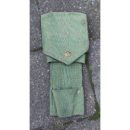
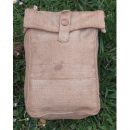
All components were made from heavy-duty, woven cotton webbing and stitched with heavy-duty, cotton thread. Brass fittings — sliders, buckles, and press-studs — were used throughout, providing strength and allowing ease of adjustment in the field. The system was modular, comprising the belt, braces (suspenders), ammunition pouches, bayonet frog, water-bottle carrier, entrenching tool carrier, small and large packs, and later specialist items such as binocular, compass.
The webbing was originally undyed, then treated with Blanco or K.G.3 colouring to darken and protect the surface. This created unit-level shade variations that help collectors identify period and theatre differences.
Service Use:
Adopted across the British Empire and Commonwealth forces, the Pattern 1937 system remained in production and front-line service from 1939 through the late 1950s. It saw action in every major campaign of the Second World War and in later conflicts including Korea, Malaya, and the early Borneo Confrontation. Numerous allied and licensed versions were manufactured by Canada, India, Australia, and South Africa, each showing subtle differences in weave, fittings, and construction detail.
The Pattern 1937 web equipment continued in limited service with Territorial units and other secondary units well into the 1970s. It remained an official issue for the Community Cadet Forces and Combined Cadet Force throughout the 1980s. Interestingly, the large pack is still issued within the British military prison system today — where inmates are required to keep its brass fittings highly polished, with no tarnish permitted.
Officers’ Equipment and Evolution:
The introduction of the Pattern 1937 Web Equipment marked a decisive break from the long-standing tradition of officers carrying private-purchase leather accoutrements such as the Sam Browne Belt Equipment of the First World War. The Sam Browne — a distinctive combination of waist belt and cross strap — had served as both a mark of rank and a practical means of carrying a sword, revolver, and ammunition pouch. However, by the inter-war years, its limitations in modern warfare were clear: heavy, slow to maintain, and entirely unsuited to mechanized or tropical conditions.
Officers continued to wear the Sam Browne throughout the Great War and well into the 1930s, partly out of tradition and partly due to its symbolic link to commission and authority. The leather belt remained a visible badge of class distinction within the British Army, even as its practical value diminished. Only the demands of a new kind of warfare — fast-moving, vehicle-supported, and uniform in issue — finally ended its dominance.
The transition to the Pattern 1937 system was not driven by concerns over officers standing out on the battlefield, as is sometimes assumed, but by the Army’s growing need for standardization. Producing a single, interchangeable system simplified supply, repair, and training, while ensuring that every soldier — regardless of rank — could be equipped from the same stores. Standardization reduced dependency on privately purchased gear and allowed the Army to maintain logistical consistency across theatres and units.
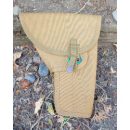
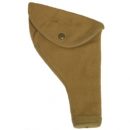
With the introduction of the 1937 Pattern system, officers were issued the same core web equipment as their men for the first time. While it was configured differently—substituting a pistol case, pistol ammunition pouch, compass case, and binocular case for rifle pouches and omitting the bayonet frog—the fundamental design remained identical across ranks. Conversely, other ranks were also issued components traditionally associated with officers when their duties required it, such as pistol holsters, map cases, or compass pouches. This practical interchangeability reflected the Army’s shift toward functional uniformity rather than social hierarchy. The change represented more than a material adjustment; it was a cultural one. The polished leather of the officer class gave way to the webbing of the professional soldier, uniting all under the same practical standard.
By 1940, official orders confirmed that officers in the field would wear Pattern 37 Web Equipment. The Sam Browne survived only as part of ceremonial and service dress, where it remains today — a relic of the Edwardian officer’s world, polished and proud, but long out of place in the mud and machinery of modern war.
International Use:
Variants and locally produced versions of the Pattern 1937 Web Equipment were used by numerous Commonwealth and allied nations during and after the Second World War. Examples include:
- Australia: Initially equipped with imported Canadian stocks, Australia soon began domestic production of Pattern 37 sets. By the latter stages of the war, an improved, uniquely Australian version was developed. Large reserves of Pattern 37 webbing remained in store and were later reissued during the Vietnam War as a stopgap when deficiencies were identified in the U.S. M1956 load-carrying equipment.
- Canada: As a major producer of Pattern 37 webbing during the Second World War, Canada supplied both domestic and Allied forces through extensive local manufacture. Canadian-made examples were fully compatible with British production and remained in service into the 1950s. Building on this experience, Canada developed the Pattern 51 Web Equipment, a modernized evolution of the Pattern 37 that retained its basic layout while introducing material and design improvements suited to post-war requirements.
- India: Continued use of Pattern 37 well into the 20th century, producing local variants for both Commonwealth and national forces.
- New Zealand: Employed the system extensively during and after the Second World War. Following the adoption of Pattern 44 and the M1956 LBE in the 1960s, remaining Pattern 37 stocks were retained by territorial and cadet units.
- Belgium: Used both complete sets and individual components from the Pattern 37 and produced a local version during the 1950s.
- Netherlands: Adopted British and Australian-made examples for wartime and post-war service and later introduced a rubberized derivative, the M1978 Web Equipment.
- Greece: Received Pattern 37 through British supply during the Second World War and issued it to the Greek Armed Forces in the Middle East and later the post-war Hellenic Army. Locally produced copies of several components remained in use until replaced by U.S. equipment in the 1950s.
- Ireland: Retained Pattern 37 from the Second World War through the 1970s, with limited ceremonial use continuing into the early 2000s.
- Israel: Inherited large quantities from British stocks and produced local variations influenced by its design. Examples remained in use into the 1960s.
- Nigeria: Retained Pattern 37 webbing as late as the Nigerian–Biafran War of the late 1960s.
Across these users, the Pattern 37’s strength, adaptability, and availability ensured a service life far beyond its intended period, securing its place as one of the most enduring webbing systems of the 20th century.
Technical Evaluation:
The Pattern 1937 Web Equipment represented a robust and highly adaptable design that proved effective across multiple theatres and climates. Its modular structure allowed individual items to be repaired or replaced without discarding the entire set.
Although heavier when wet and prone to mildew in humid environments, the system’s strength, simplicity, and ease of production made it the most successful webbing of its era. Lessons learned from its performance—particularly in terms of interchangeability and standardization—directly influenced the design of the Pattern 1944 Web Equipment.
Summary:
The Pattern 1937 Web Equipment served as both a practical load-carrying system and a landmark in military design philosophy. It replaced the class-bound leather equipment of earlier generations with a unified, functional issue for all ranks, setting the template for post-war systems across the Commonwealth.
Its widespread adoption and adaptation by allied nations—from Australia’s wartime production and Vietnam-era reissue to Canada’s development of the Pattern 51 Web Equipment—demonstrated its strength, versatility, and enduring influence. From India to Israel and beyond, the Pattern 37’s balance of simplicity and standardization established the foundation upon which much of the 20th century’s web equipment would be built.
Pattern 37 Web Equipment Objects:
Click here to view the full list of objects attached to this tag.
