
Pattern 58 Web Equipment
Lineage:
Overview:
The Pattern 1958 Web Equipment was introduced in the late 1950s as a modern, modular load-carrying system suitable for both temperate and tropical climates. It defined the standard for British infantry throughout the Cold War, remaining in front-line use well into the 1990s.
Its development reflected post-war doctrine, which assumed that future conflicts would be fought by troops transported in trucks and armoured personnel carriers rather than by long-range infantry on foot. The 58 Pattern therefore prioritized rapid mobility and modular configuration over the endurance-marching ethos of its predecessors.
Design and Construction:
Fabricated from cotton canvas webbing dyed SCC-15 green, the 58 Pattern retained the alloy hardware of the earlier Pattern 44 Web Equipment, providing durability and corrosion resistance while reducing glare. The subdued, low-reflective finish simplified upkeep and remained visually consistent across production runs.
The system was designed around new mechanized-warfare principles—favouring compact loads and quick reconfiguration for mounted infantry. It was optimized for the L1A1 Self-Loading Rifle (SLR) and related accessories, including rifle grenades and bayonets.
The web set was worn in three configurations:
- Skeleton Order – belt, suspenders, and ammunition pouches for range or training use.
- Complete Equipment Fighting Order (CEFO) – the full set, minus the large pack.
- Complete Equipment Marching Order (CEMO) – the full set with the large pack attached.
Key components included:
- Reinforced waist belt with quick-adjust buckle.
- Padded yoke distributing weight evenly across the shoulders.
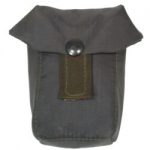
- Left and right ammunition pouches, the left incorporating a bayonet frog and the right featuring a pocket for a rifle-grenade adapter.
- Water bottle carrier with plastic water bottle and plastic cup.
- Twin rear “kidney” pouches for rations and personal kit.
- Poncho or “cape” carrier.
- A large pack that could be rapidly detached from the webbing yoke, allowing the soldier to “quickly” drop the large pack before or during combat.
Each element was fully interchangeable, allowing soldiers to tailor their setup to the mission or climate.
Service Use:
Officially introduced in 1959, the 58 Pattern Web Equipment served as the primary British Army load-bearing system for over three decades. It saw widespread use throughout the Cold War, including deployments to Northern Ireland, Aden, Borneo, Cyprus, Belize, and the Falklands, and remained in limited service into the early 1990s.
Even after its replacement by the 90 Pattern PLCE, it remained in service cadet and reserve forces for a number of years. The design also inspired several export and locally produced variants around the world.
Officers’ Equipment:
Unlike its predecessors, the Pattern 1958 Web Equipment did not include a dedicated officer’s configuration. It was conceived as a universal issue adaptable to any role through interchangeable components, removing the need for rank-specific layouts. Officers, NCOs, and enlisted soldiers drew the same webbing from unit stores and configured it as required.
This design ended the notion of officers merely directing their sections from a distance; it placed them directly in the fight—leading, maneuvering, and engaging alongside their men. The Pattern 58 reflected the Army’s post-war emphasis on standardization, practicality, and shared responsibility in combat.
Specialist pouches such as the compass case, binocular case, and pistol holster were part of the system but were only issued when the corresponding item of equipment was drawn. These were functional allocations rather than symbols of rank distinction. The Pattern 58 therefore marked the complete end of officer-specific web sets, reinforcing the principle that all ranks operated from the same foundation.
International Use:
Variants and derivatives of the Pattern 1958 Web Equipment were produced or adopted by a number of allied and Commonwealth countries. Examples include:
- New Zealand: Trialed in the early 1960s, but rejected due to concerns over performance in jungle conditions.
- Pakistan: Produced under license and exported widely to regional and African militaries; still encountered in use today.
- Rhodesia: Utilized the South African Pattern 61 Web Equipment, a derivative of the 58 Pattern, in locally adapted configurations.
- South Africa – Developed the Pattern 61/64 web equipment based on the British Pattern 58 design, then produced the Pattern 70 webbing as an evolution of the 61/64 layout.
- Oman and Gulf States: Received British-made or Pakistani-produced export sets for internal security and border units.
- Malaysia: Produced locally made versions of the 58 Pattern ammunition pouches for use with the M-1970 Web Equipment.
Technical Evaluation:
In concept, the 58 Pattern successfully bridged the gap between traditional marching systems and the vehicle-borne infantry era. Its modularity and simplified fittings made it more comfortable and adaptable than previous designs, and its balance suited the body armour and NBC gear introduced in later decades.
However, in tropical environments its cotton canvas absorbed water, became heavy when wet, and dried slowly—a significant drawback compared with the synthetic systems that followed. In practice, wet webbing took many hours to dry, often leading to abrasion injuries, and in arctic conditions, the pouches froze and became difficult to use. When the large pack was carried for long periods, its flat-backed design prevented airflow, causing discomfort on extended marches.
The web set carried, in theory, enough equipment to sustain a soldier for 24 hours in CEFO and 48 hours in CEMO. Soldiers frequently modified their webbing: replacing the standard belt with a roll-pin buckle belt, cutting off the entrenching-tool holder to wear a field pack more comfortably, substituting the rear pouches for additional water-bottle carriers used as utility pouches, or swapping the issued water bottle carrier for a Pattern 44 water-bottle carrier. Some omitted the cape carrier entirely. With no dedicated bag for the vacuum-packed NBC suit, many troops improvised by strapping a second cape carrier on top of the rear pouches.
These field adaptations reflected the system’s flexibility and the ingenuity of its users, ensuring the 58 Pattern remained relevant until 90 Pattern PLCE finally took over.
Summary:
The Pattern 1958 Web Equipment marked the end of Britain’s cotton webbing based lineage and the beginning of modern modular load systems. Serving soldiers for over three decades, it remains one of the most recognizable and enduring designs of the Cold War era.
By eliminating rank-specific issue and standardizing modularity, the Pattern 58 laid the groundwork for later nylon developments—most notably the Mk.2 nylon Pattern 58, designed to improve NBC decontamination—alongside the 72 and 85 Patterns. Later webbing, including the 90 Pattern PLCE and subsequent systems, continued this evolution, creating a shared design language across NATO and Commonwealth armies
Pattern 58 Web Equipment Objects:
Click here to view the full list of objects attached to this tag.
Lineage:
