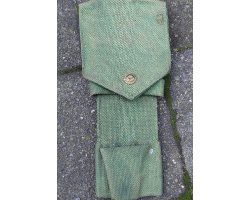
Frog, Cutter, Wire, Folding. (Mk I)
British Frog, Cutter, Wire, Folding (Mk I), developed during the First World War to carry folding wire cutters and remaining in service until the 1990s.
United Kingdom


British Frog, Cutter, Wire, Folding (Mk I), developed during the First World War to carry folding wire cutters and remaining in service until the 1990s.
The Pattern 1937 Web Equipment was the standard British load-carrying system of the Second World War, evolving from earlier designs into a more adaptable and widely issued set. Used across all theatres, it reflected a shift toward modular equipment suited to modern infantry operations.
Read More »
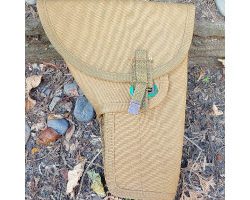
The Holster, C, No.2, Mk II was designed to carry the Inglis 9 mm Browning Hi-Power pistol, along with a cleaning rod and spare magazine. It was developed and produced by Canada in the closing years of the Second World War in response to shortcomings identified in the earlier Holster, C, No.1, Mk I—a Chinese-designed holster pattern originally produced for Chinese forces.

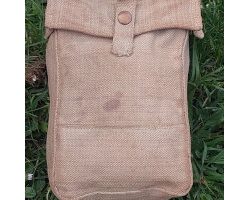
In early 1942, Australia recognized the need to redesign the Pattern 37 web equipment based on combat experience in the Pacific against Japanese forces. The standard Basic Pouches were found to be too small to carry sufficient amounts of ammunition and munitions for the challenging conditions of jungle warfare.
Read More »

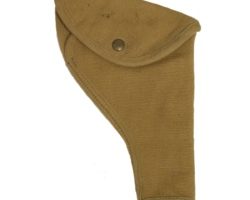
The Case, Pistol (Large Frames) is a khaki-tan holster with a curved lid that snaps shut. Designed by Canada for a .455 Smith and Wesson revolver, it’s a close copy of the standard issue and includes hooks for attaching to a web belt.
Read More »
