
Rucksack, Inf (Infantry), Long/Short Back
General Information
Name: Rucksack, Inf (Infantry), Long/Short Back.
Rucksack, Infantry (Inf), Long Back.
Country of Origin: The United Kingdom.
Date of Production: See individual objects.
Manufacturer: See individual objects.
NATO Stock Number (NSN): See individual objects.
Contract Number: See individual objects.
Camouflage Pattern: See individual objects.
Equipment Family: 90 Pattern Web Equipment.
Number Of compartments: Four.
Volume Capacity: 100L.
Weight: See individual objects.
Dimensions: See individual objects.
Waterproof: Yes, but depends on the condition of the fabric.
Frame: Internal.
History
The Rucksack, Infantry (Inf), Long/Short Back was the main field pack issued with 90 Pattern Web Equipment and was intended to replace an entire zoo of earlier designs: the Pattern 58 Large Pack, SAS/Para Bergen, Arctic Rucksack, Arctic Patrol Pack, General Service Bergen, and even the Berghaus Cyclops Roc and Crusader bergens used by certain specialist units. Its design lineage is heavily influenced by the Crusader bergen and follows on from concepts first trialed in the Pattern 85 Web Equipment programme.
Issued in two back lengths — Short Back for personnel under 6 ft and Long Back for those over — the rucksack embraced a modular approach. The large removable side pouches could be zipped together and worn as a stand-alone patrol pack, making the system far more adaptable than anything previously issued. Constructed from textured nylon, it was markedly superior to the older woven cotton webbing and nylon-Butynol packs — at least on paper.
However, it wasn’t without its quirks. A major criticism was that when worn with the 90 Pattern webbing, the two systems would fight for space on the wearer’s back. Instead of floating above the webbing, the rucksack’s weight often ended up sitting on the top of the web set. This forced the webbing suspenders to carry loads they were never designed to take, causing discomfort and long-term strain. As a result, many soldiers opted for the Short Back version even when they officially measured for a Long Back, simply to reduce the clash with the web set.
Early internal frames also proved too weak for the loads some units needed to carry. Later iterations corrected this, but not before a fair number of frames were bent or broken in the field.
The rucksack entered large-scale production around 1988–1989, and began appearing with British units in 1990, just in time for its first major trial: the Gulf War. In the desert it performed well and showed the value of its modular design. But the jungle told a different story. Designed with Europe and Norway in mind — open terrain, cold climates — the rucksack struggled in dense tropical environments. The height of the fully loaded lid and the outward bulk of the side pouches snagged on vegetation, and the minimal back ventilation caused overheating, making the system unpopular in jungle conditions.
Despite its flaws, the 90 Pattern Rucksack developed a following outside the UK. While it was only officially issued to British troops, soldiers from New Zealand and other Commonwealth forces who could privately purchase one often favoured it over their locally issued packs due to its robustness and adaptability.
In standard issue form it was perfectly serviceable, but British soldiers — and certain special forces elements — routinely pushed it further. Many packs were modified with extra pouches, floating lids, reinforced frames, or layout tweaks to suit long-duration living and unit-specific requirements.
Loved, hated, and endlessly chopped about, the 90 Pattern eventually evolved into a true Franken-pack — a reflection of the soldier more than the manufacturer. It was finally superseded by the Virtus system in 2016, though even after replacement, many troops still preferred the old 90 Pattern. Its durability, simplicity, and ability to be tuned to the individual kept it relevant long after its official retirement.
Description
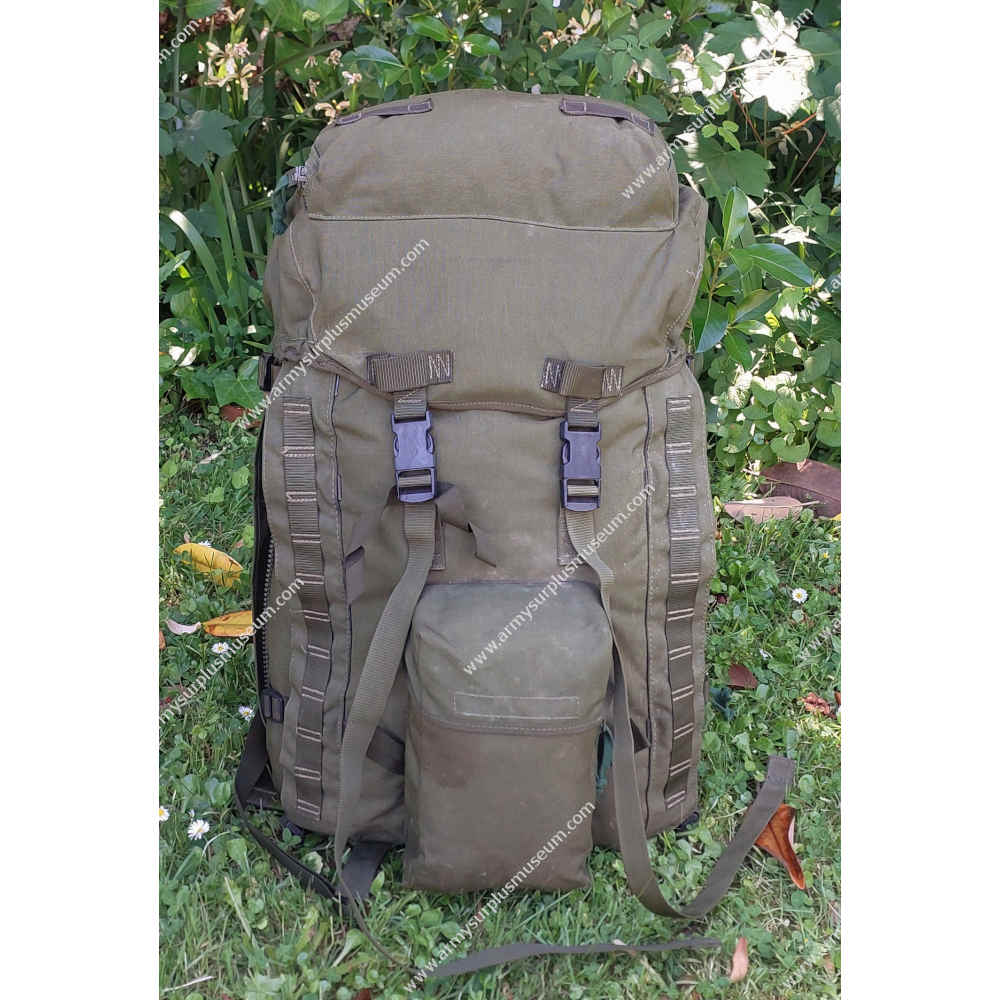
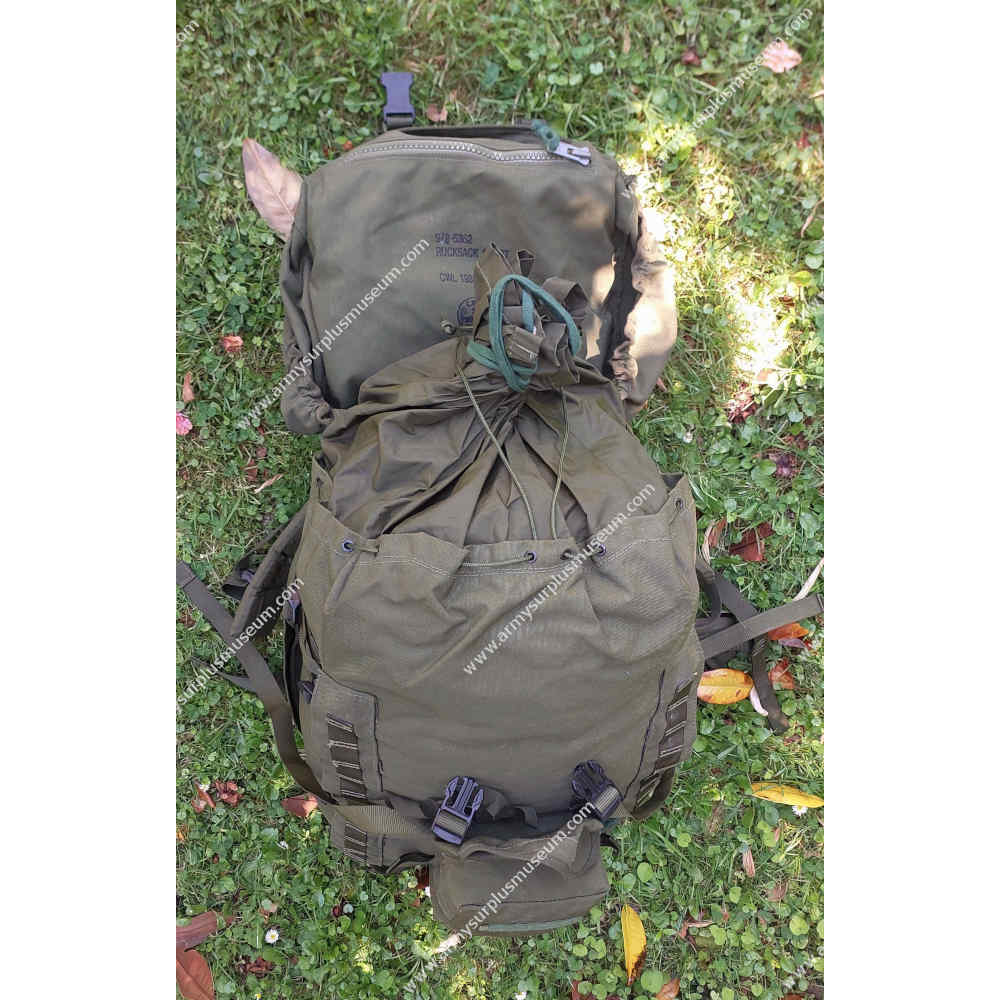
The rucksack is fabricated from 1000-denier Cordura-style nylon. The lid features a large external pocket with a side-entry heavy-duty plastic zip. At each corner of the pocket are nylon webbing loops, allowing items to be secured to the top, and between the rear pair a grab handle is formed.
The lid is permanently sewn to the back of the rucksack and closes at the front using two plastic side-release buckles on webbing straps. Above the female buckles is a third set of nylon loops for additional lashing. The lid is shaped to fully close over the mouth of the rucksack and is elasticated at both sides with shock cord.
The underside of the lid contains a large flat map pocket with a front zip entry. At the base of the lid (rear edge) is a nylon loop at each end.
The mouth of the rucksack has a nylon draw-cord and fix-lock. Sewn inside the mouth is a long green nylon snow-collar with its own draw-cord and fix-lock for additional security.
Internally, the rucksack has a full-length flat compartment closed by a Velcro and metal-dome flap. Inside this compartment are three full-length nylon Cordura channels that hold the stays of the internal frame, allowing the frame to be easily removed and enabling the compartment to function as a full-length flat pocket. The base of this compartment is reinforced with a second layer of textured nylon fabric.
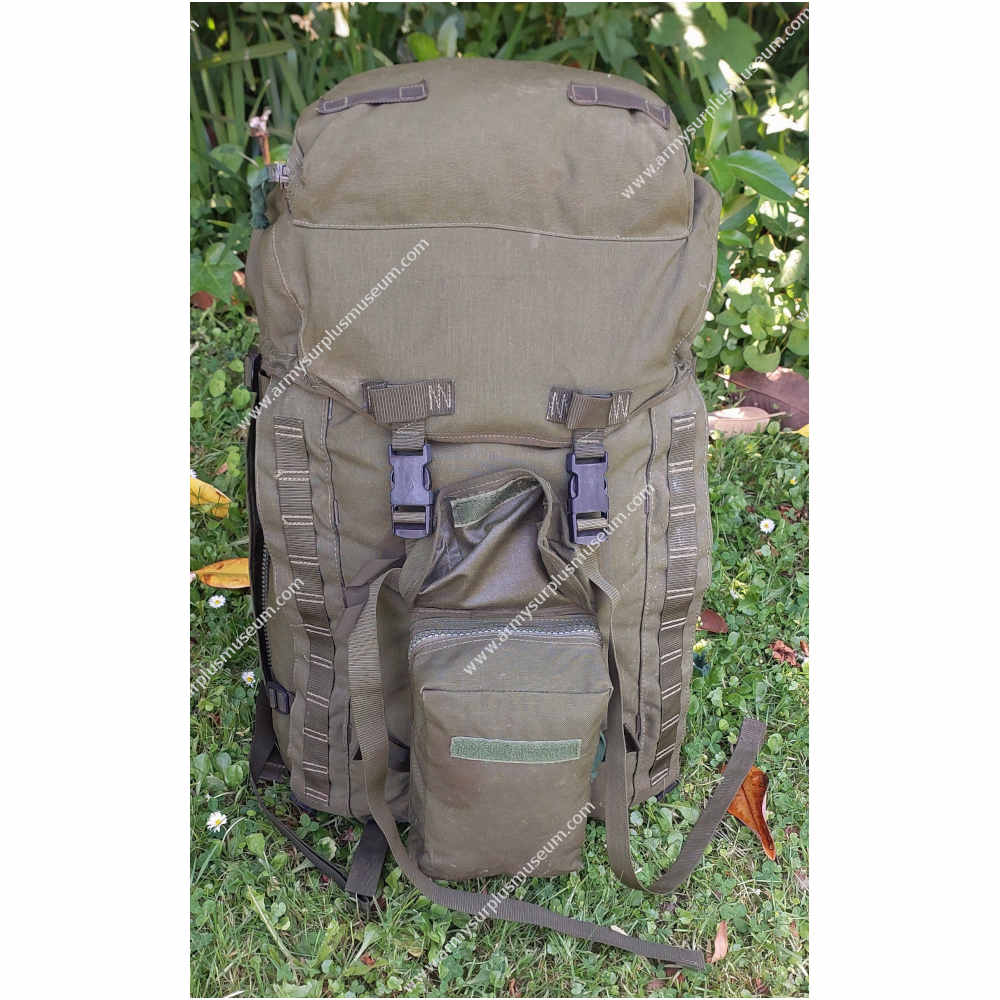
The front of the rucksack features a Cordura cover that protects the side-pouch zips. Externally on this cover is a panel of nylon webbing stitched down to create ten vertical loops on each side, allowing items to be strapped or bunggied to the front.
At the bottom front of the rucksack is a medium-sized box-shaped pouch with a three-quarter-length heavy-duty zip around the top. A shaped lid covers the zip and is secured with hook-and-loop closure. On each side of this pouch are nylon webbing loops for securing ice axes or similar tools.
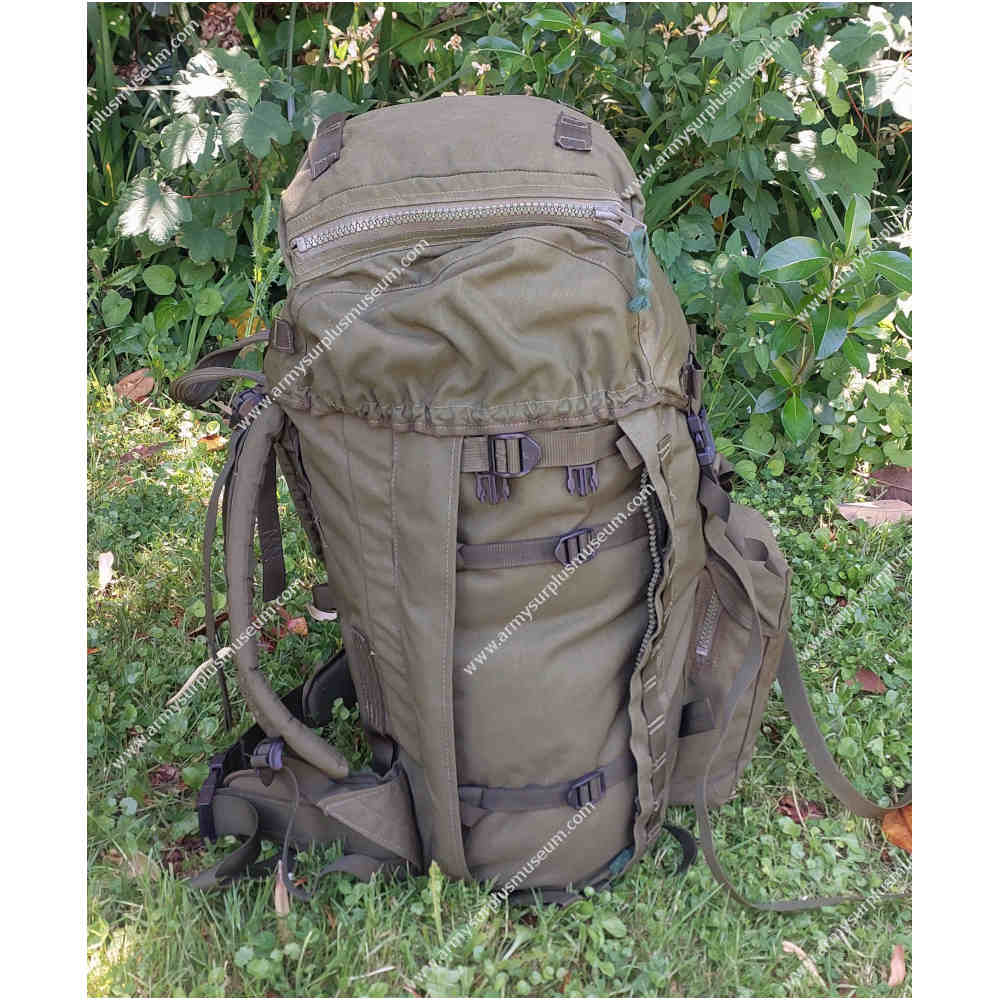
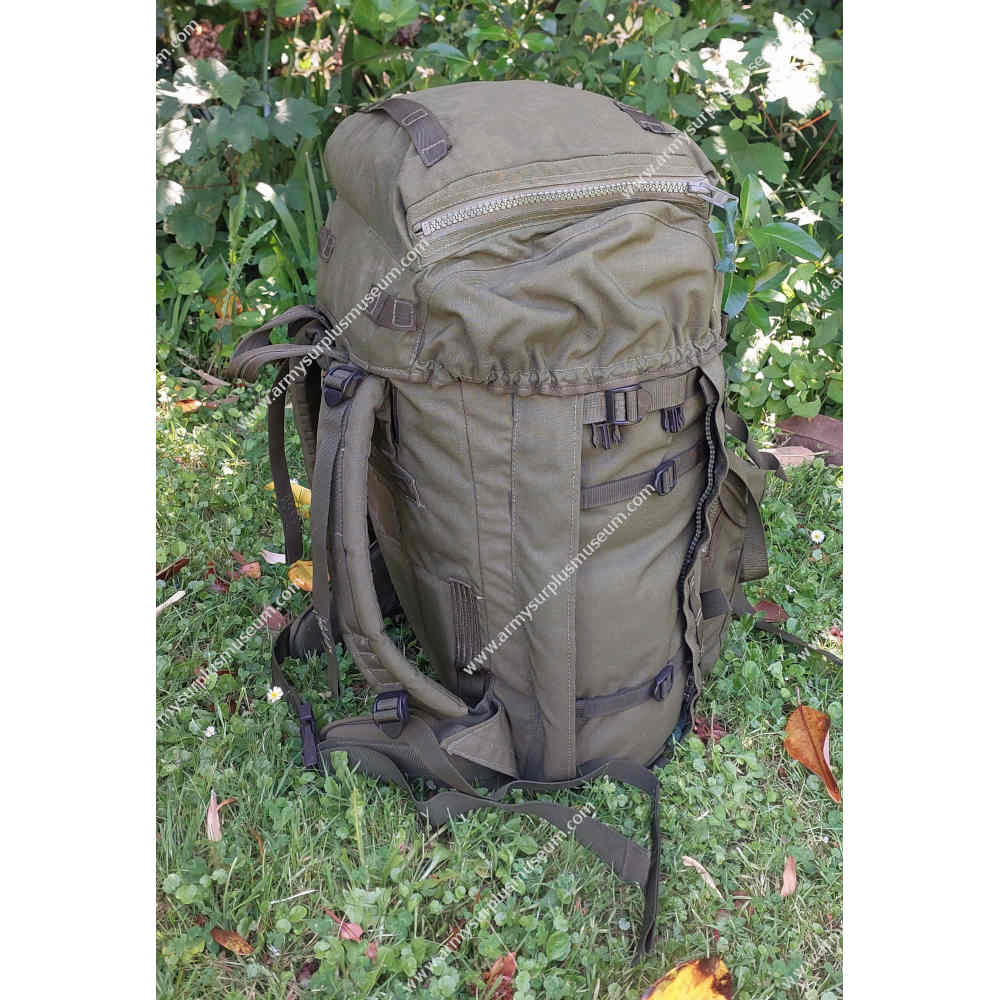
Each side of the rucksack has two sets of small side-release buckles that secure the side pouches and act as a backup if the zips fail. Full-length heavy-duty zip tracks run down both sides for attaching the pouches; these are protected by Cordura covers. Three nylon webbing compression straps are sewn down each side. The upper strap uses a plastic Super-Lock buckle. These straps compress the load, secure items externally, and, if all else fails (zips and buckles), can also be used to attach the side pouches.
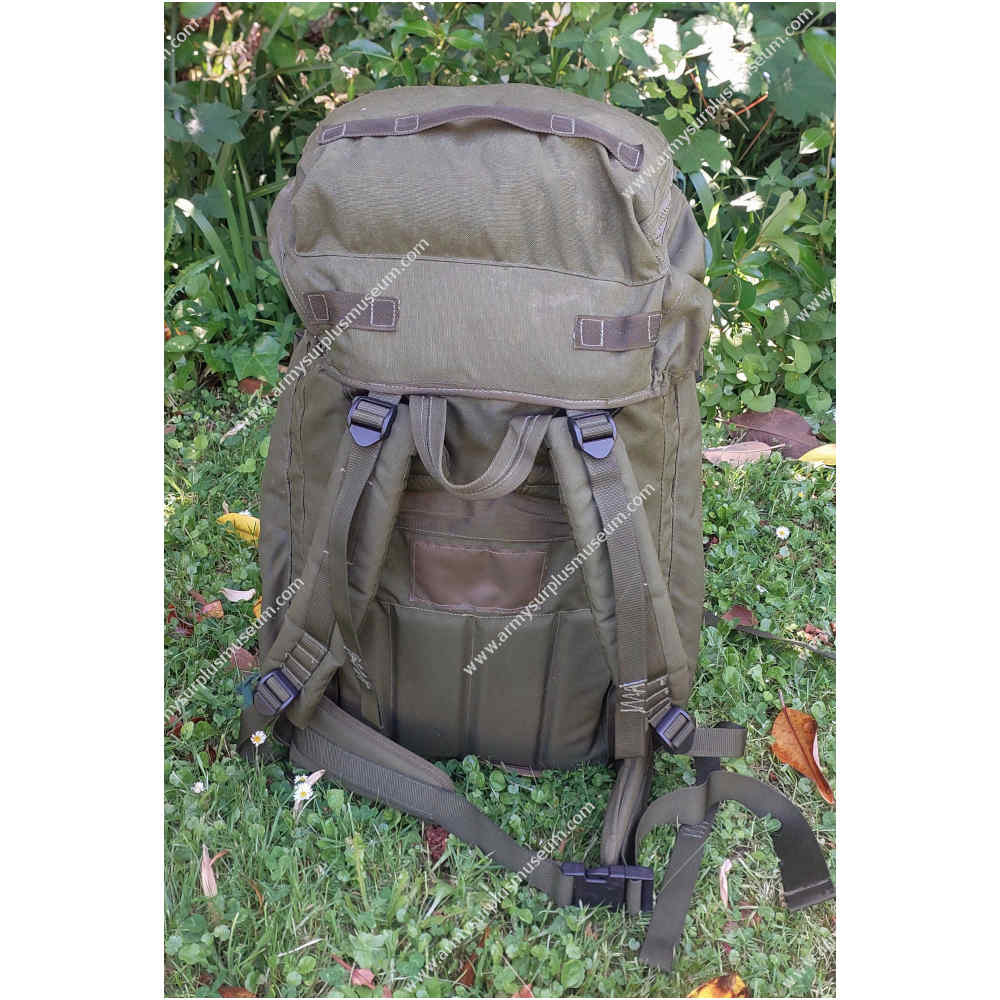
The back panel has a wide heavy-duty webbing drag handle at the top. The shoulder straps are fixed to the back; their outer faces are Cordura, the undersides are OD nylon fabric, and both are padded with closed-cell foam. At the top of each strap is a webbing cinch strap with Super-Lock buckle.
The lower ends of the shoulder straps adjust using webbing straps sewn to the base of the rucksack with Super-Lock buckles. Sewn onto the shoulder straps are vertical webbing strips forming three long loops on each strap to allow a chest strap to be fitted and adjusted.
The back of the rucksack is padded with closed-cell foam sandwiched between two layers of Cordura, quilt-stitched in a convoluted chevron pattern.
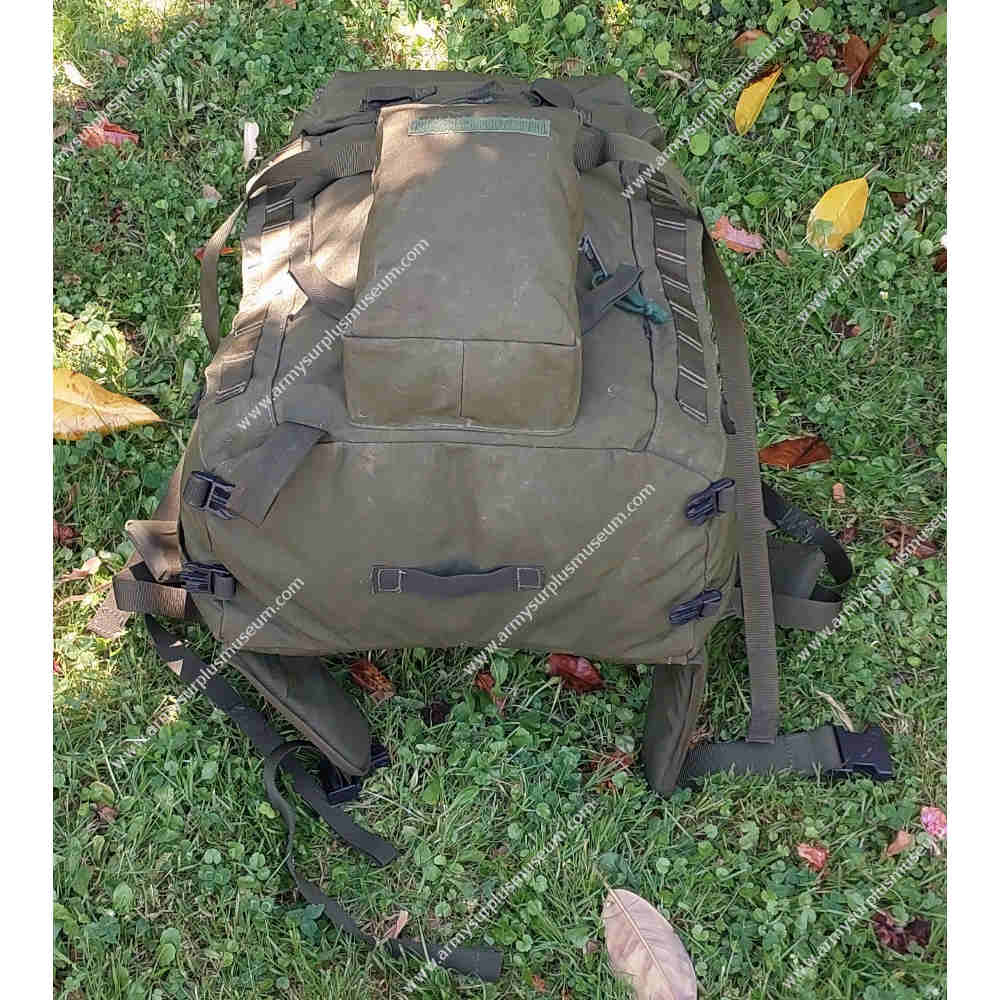
At the lower back are upward-pointing webbing loops on each side, allowing the rucksack to be fitted to a parachute harness during HALO jumps. Below these loops is the padded waist belt, built similarly to the shoulder straps and tapering at each end. It adjusts with a 35mm webbing strap and plastic side-release buckle.
The base of the rucksack is reinforced and includes a webbing handle.
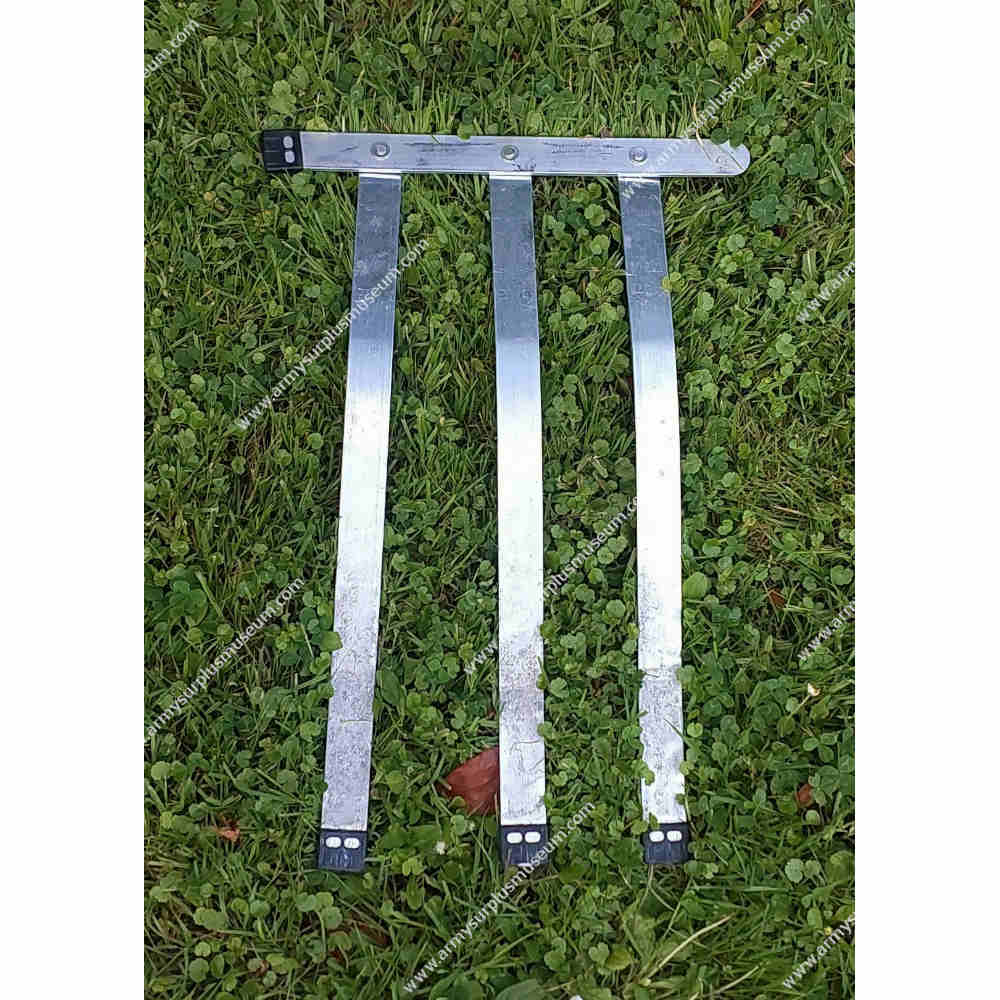
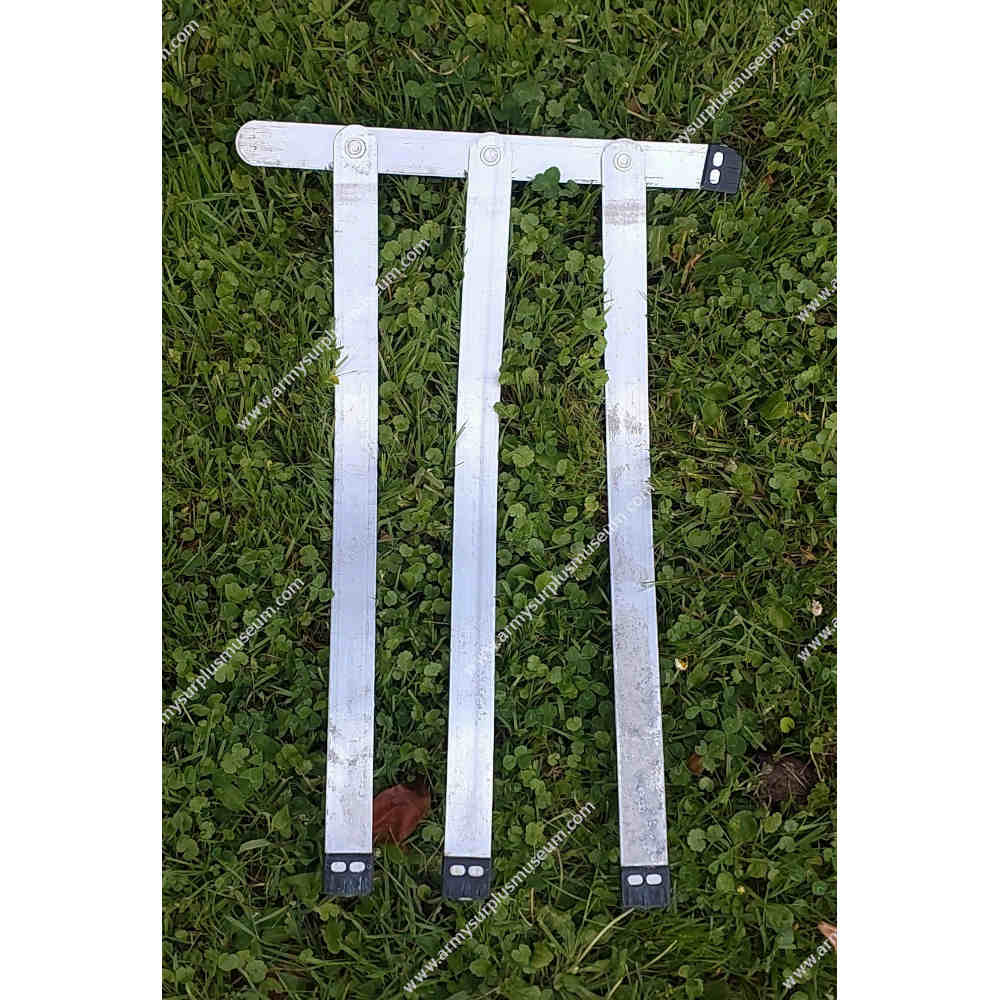
The rucksack’s internal frame consists of three evenly spaced aluminum flat-bar stays riveted together at the top with steel rivets.
Examples
Example One
Example one is a short back rucksack produced in 1989 by Chesterfield Waterproofs Ltd (CWL) and represents an early production example of the 90 Pattern rucksack, fitted with the earlier two-stay aluminium internal frame.

NATO Stock Number (NSN):
Rucksack, Infantry (Inf), Short Back with frame- 8465-99-978-5362.
Rucksack, Infantry (Inf), Long Back with frame- 8465-99-978-5360.
Rucksack, Infantry (Inf), Short Back- 8465-99-978-5363.
Rucksack, Infantry (Inf), Long Back- 8465-99-978-5361.
Contract Number:
Colour: Olive Green (OG).
Volume Capacity:
Top lid compartment- 8L.
Internal, flat lid compartment- 8L.
Main compartment- 90L.
External compartment- 5L.
Weight: 2.4kg.
Dimensions (cm): 45cm (H) × 36cm (W) × 21cm (D).
Object Number: 3124-826-45103.
Example Two (Modified)
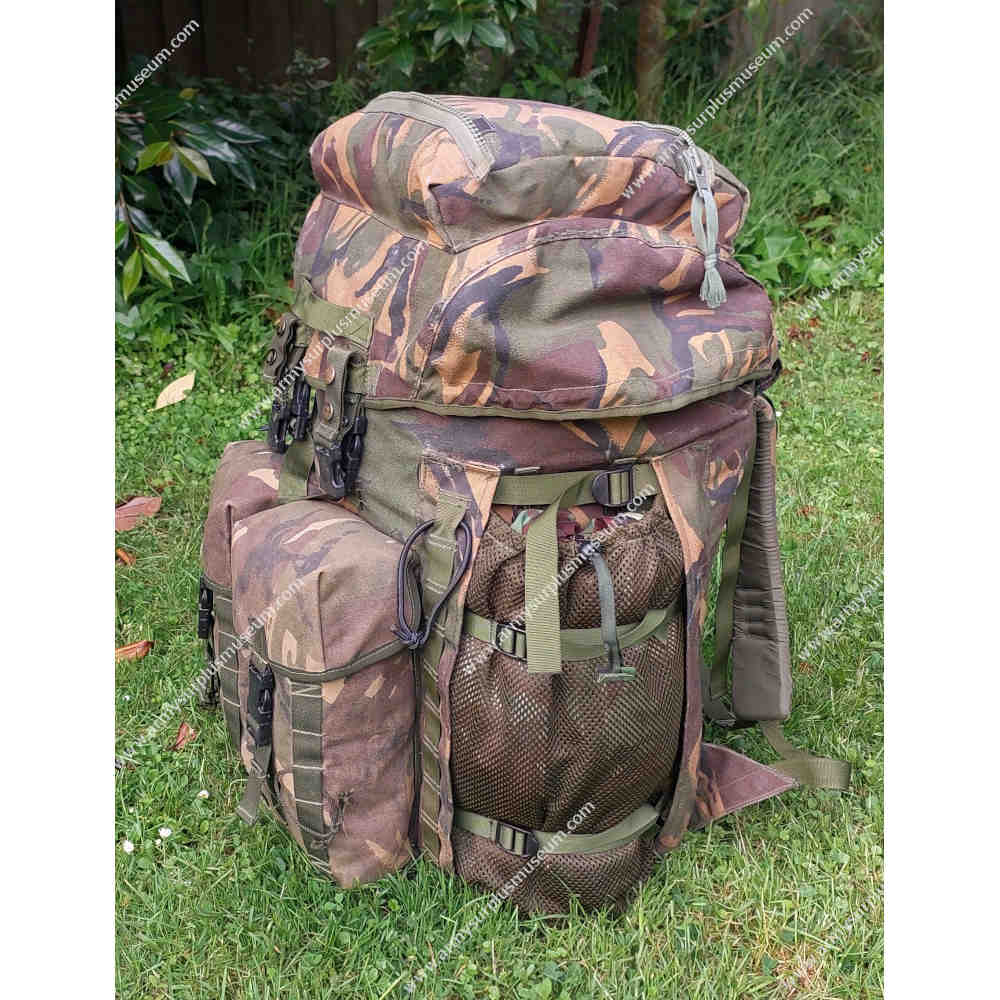
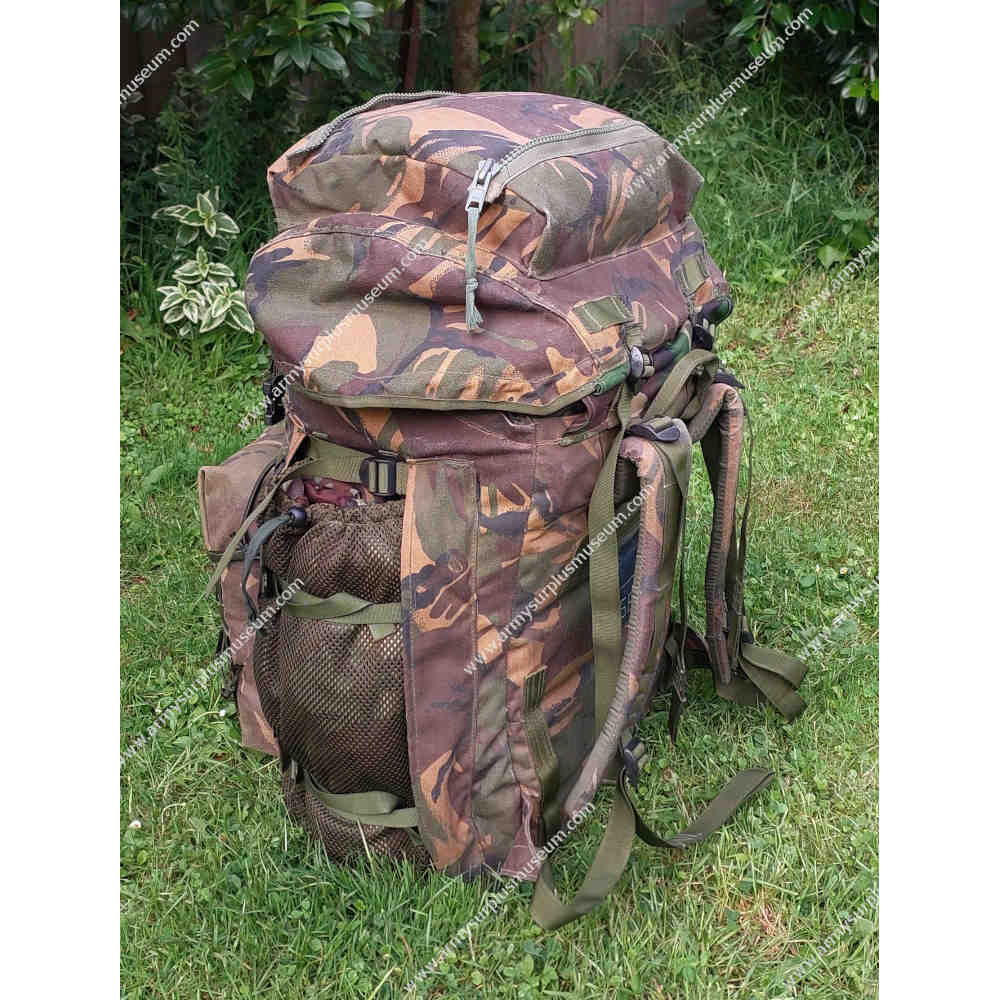
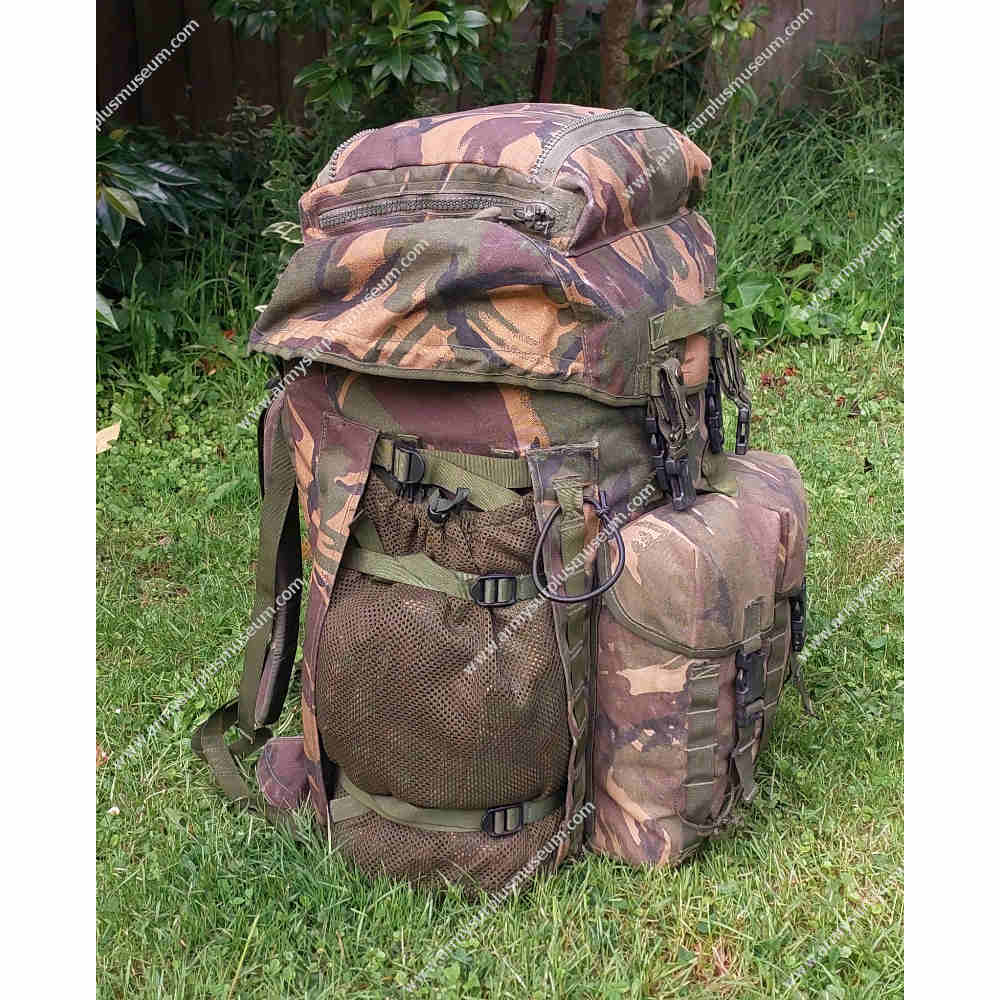
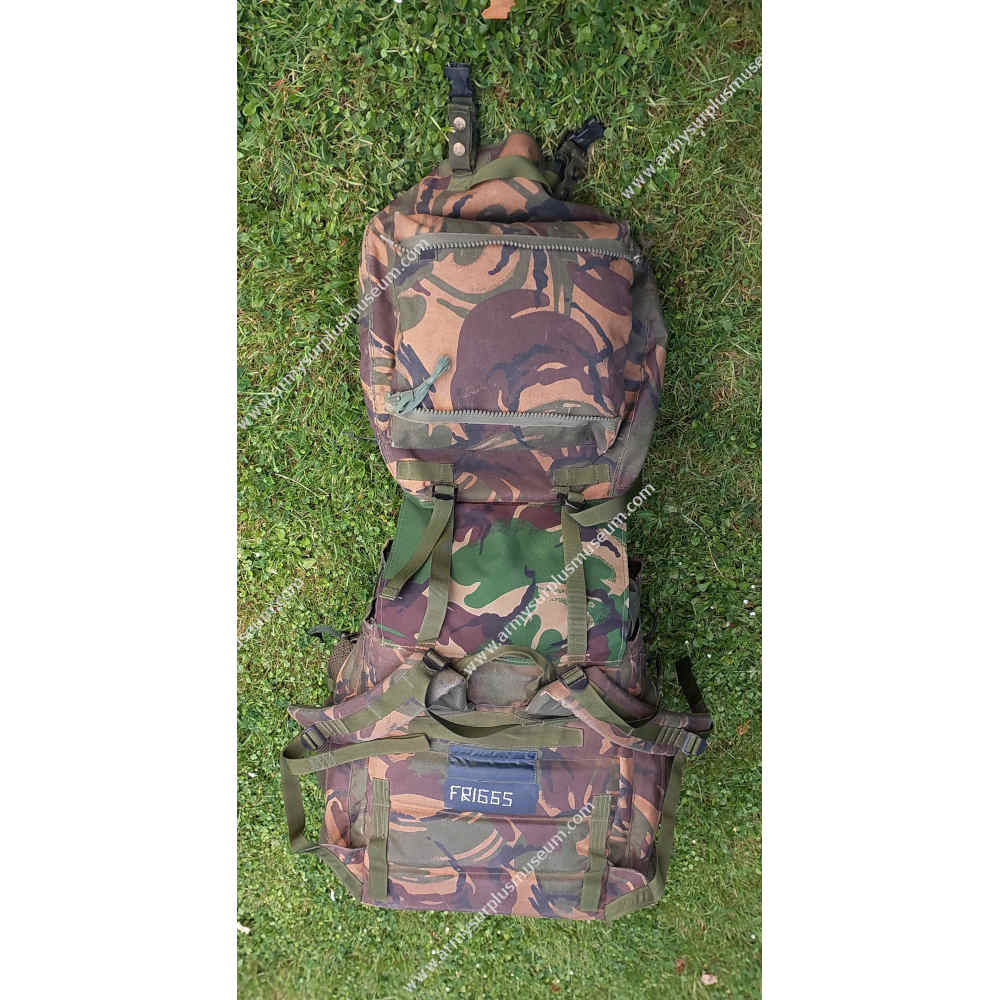
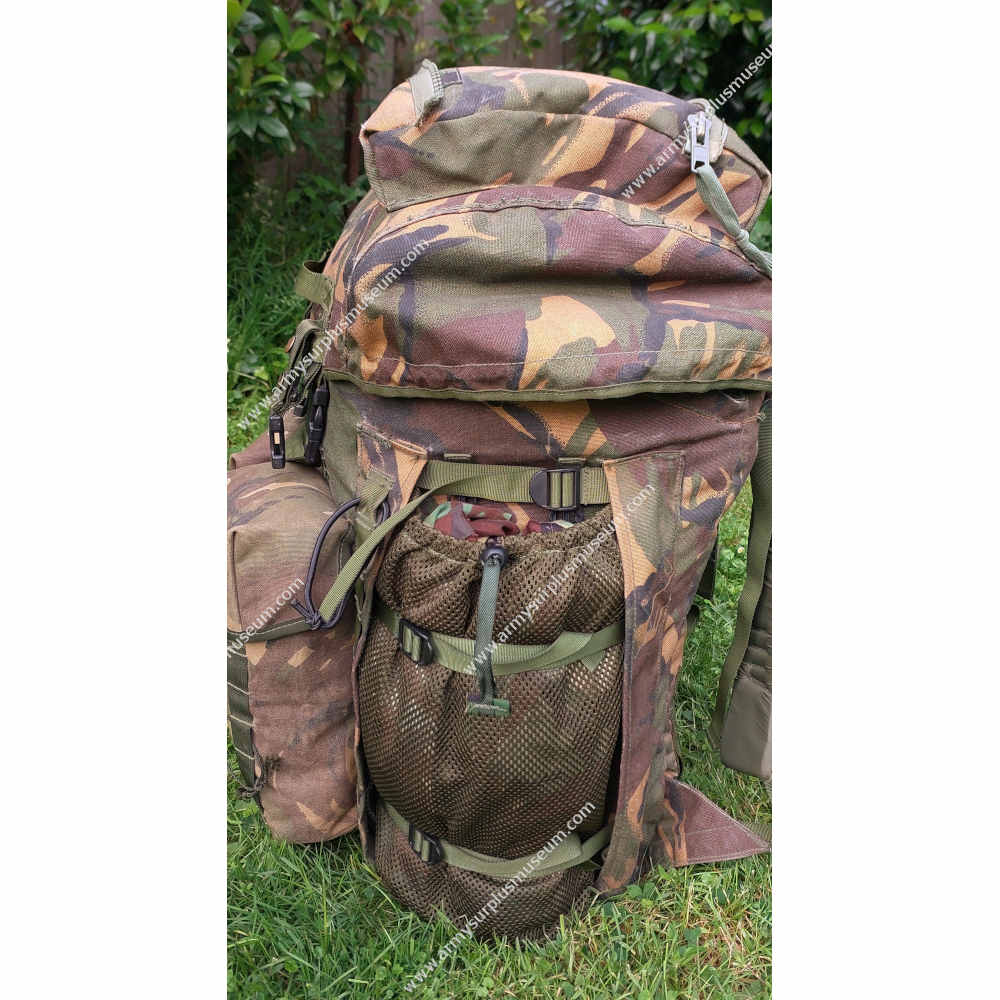
Example two is a short back rucksack produced by an unknown manufacturer in 2007 and modified at a later date by the individual user. These modifications give the rucksack a slimmer profile while increasing overall carrying capacity, removing the need to add the standard side pouches. The lid has been extensively reworked and fitted with an additional set of zip sections, allowing a third side pouch to be attached in the same manner as the Field Pack, Air, Support.
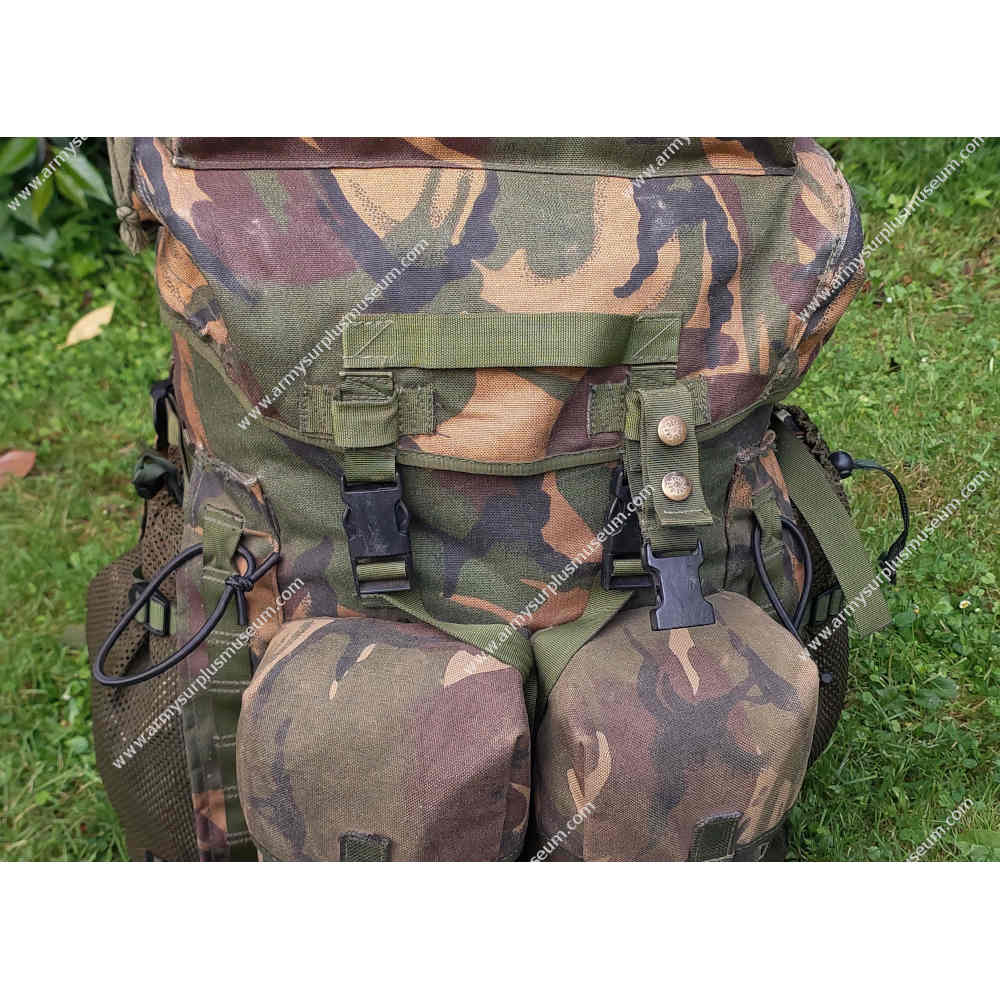
The lid has also been converted into a floating lid by the addition of a section of DPM nylon between the lid and the body of the rucksack. This extension is tensioned using three rear-mounted webbing straps and buckles. As a secondary attachment and redundancy measure, the lid incorporates two Strap Fastener (Loop) components taken from the rear of the Combat Body Armour (CBA) vest, providing an additional side-release attachment point should the primary buckles fail.
Both sides have flat mesh pouches sewn in between the original zip channels, providing extra external storage while still allowing the side pouches to be attached. When the side pouches are fitted, the mesh pockets remain usable as small flat compartments.
On the front, the original lower pouch has been completely removed. In its place are two side pouches from the Patrol Pack, 30L, NI (Northern Ireland) sewn directly to the front panel. Two large elastic loops have also been added at the top to secure a rolled waterproof or similar item.
As is common among soldiers, the waist belt has been removed, as it can delay dumping the rucksack during a sudden contact. In an ambush, soldiers must shed their rucksack immediately to engage the enemy, and a fastened waistband becomes an unnecessary obstruction. Removing the waistband entirely also prevents the loose ends from flapping around or getting in the way when the belt is not used.







NATO Stock Number (NSN):
Rucksack, Infantry (Inf), Short Convoluted Back, DPM, IRR- 8465-99-978-9221.
Rucksack, Infantry (Inf), Long Convoluted Back, DPM, IRR- 8465-99-978-9220.
Contract Number: DC1aESL/0156.
Camouflage Pattern: Temperature Disruptive Pattern (DPM).
Number Of compartments: Six.
Volume Capacity: 128L.
Top lid compartment- 8L.
Internal, flat lid compartment- 0L.
Main compartment- 90L.
External pouches- 5L each.
Mesh pouches- 10L each.
Weight: 3.5kg.
Dimensions (cm): 45cm (H) × 36cm (W) × 21cm (D).
Object Number: 3124-826-45104.
Example Three (Modified)
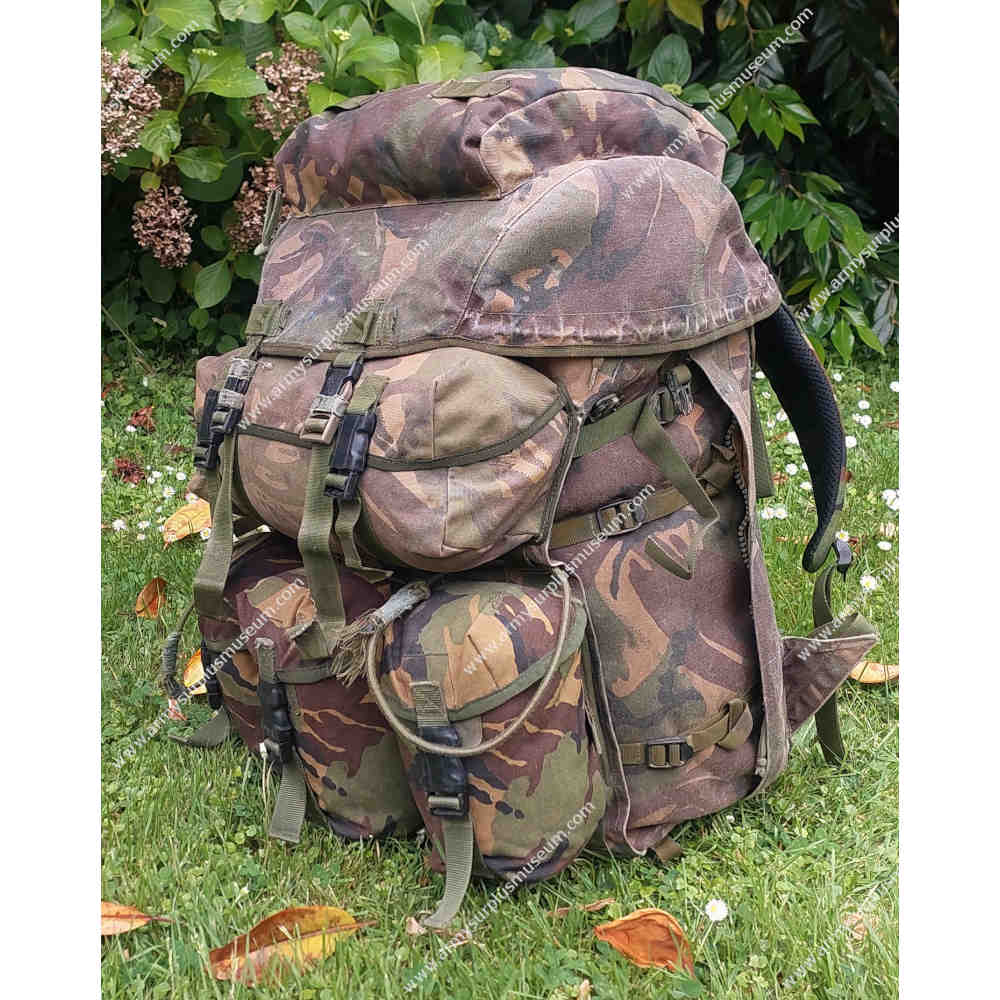
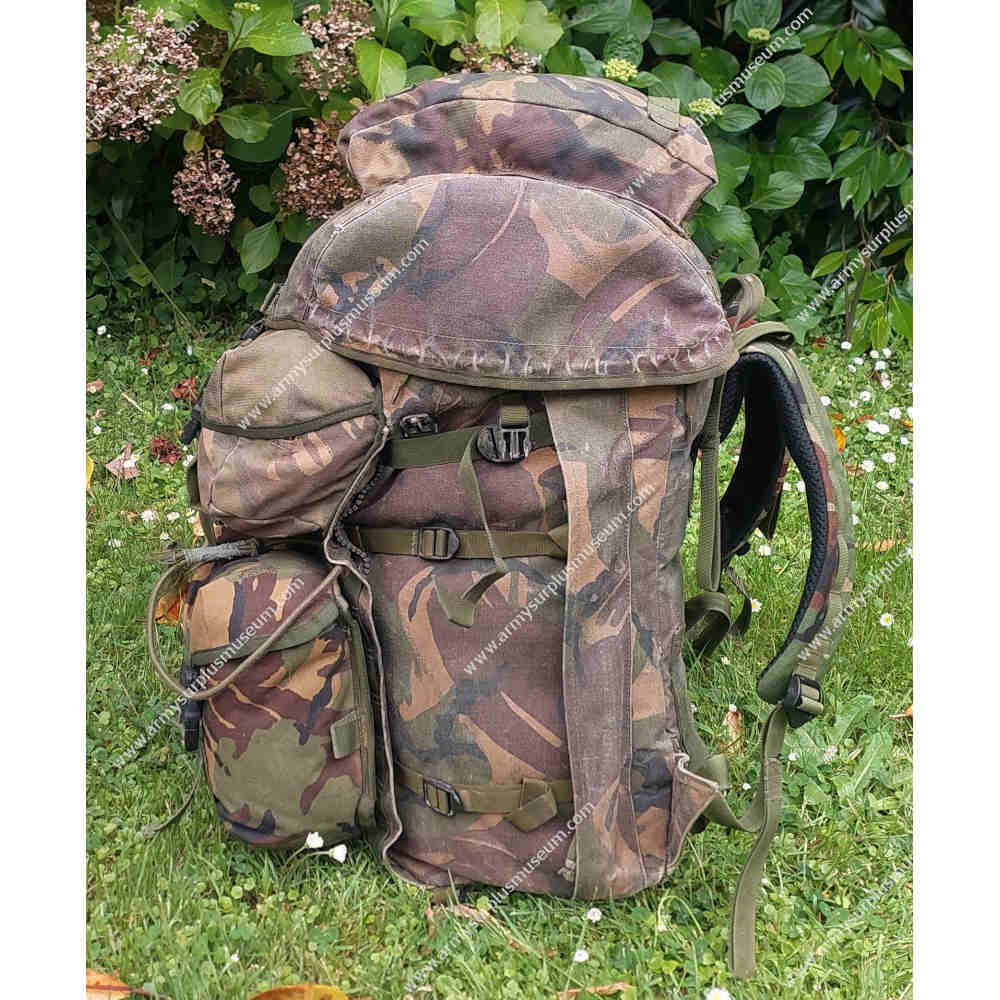
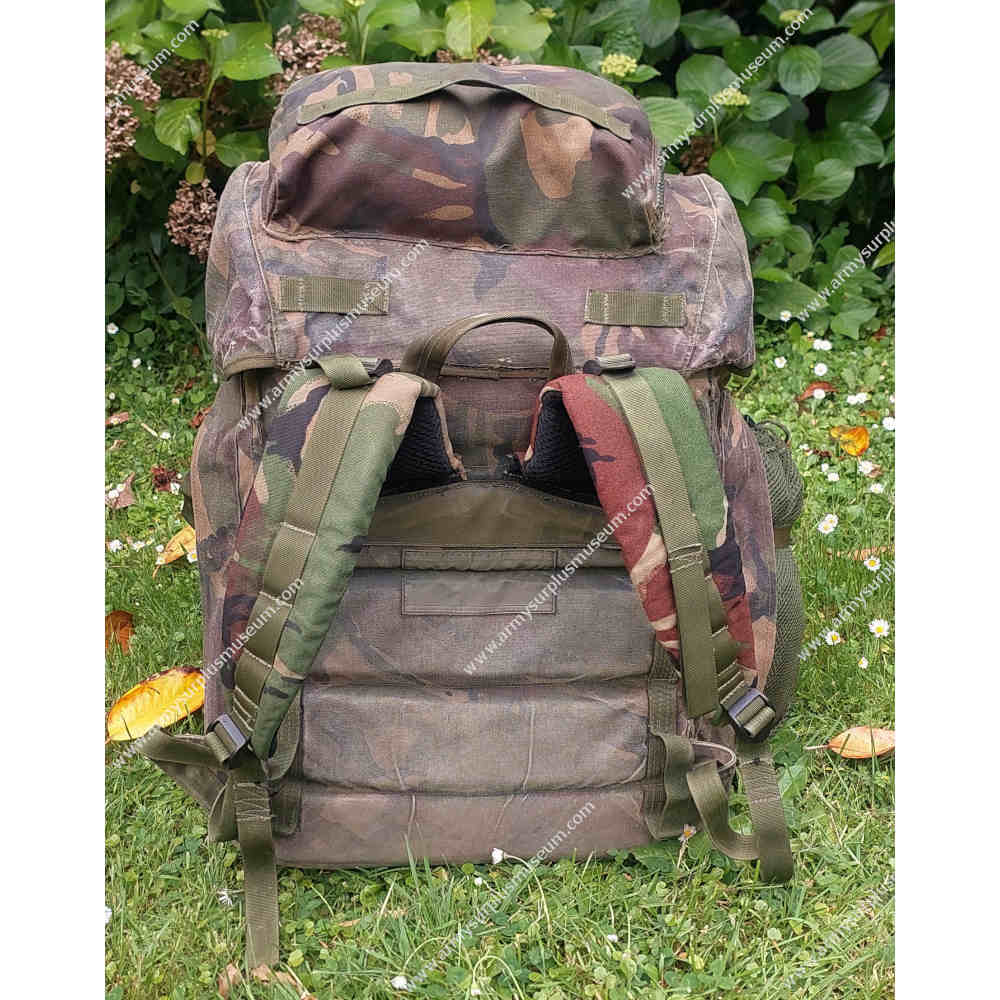
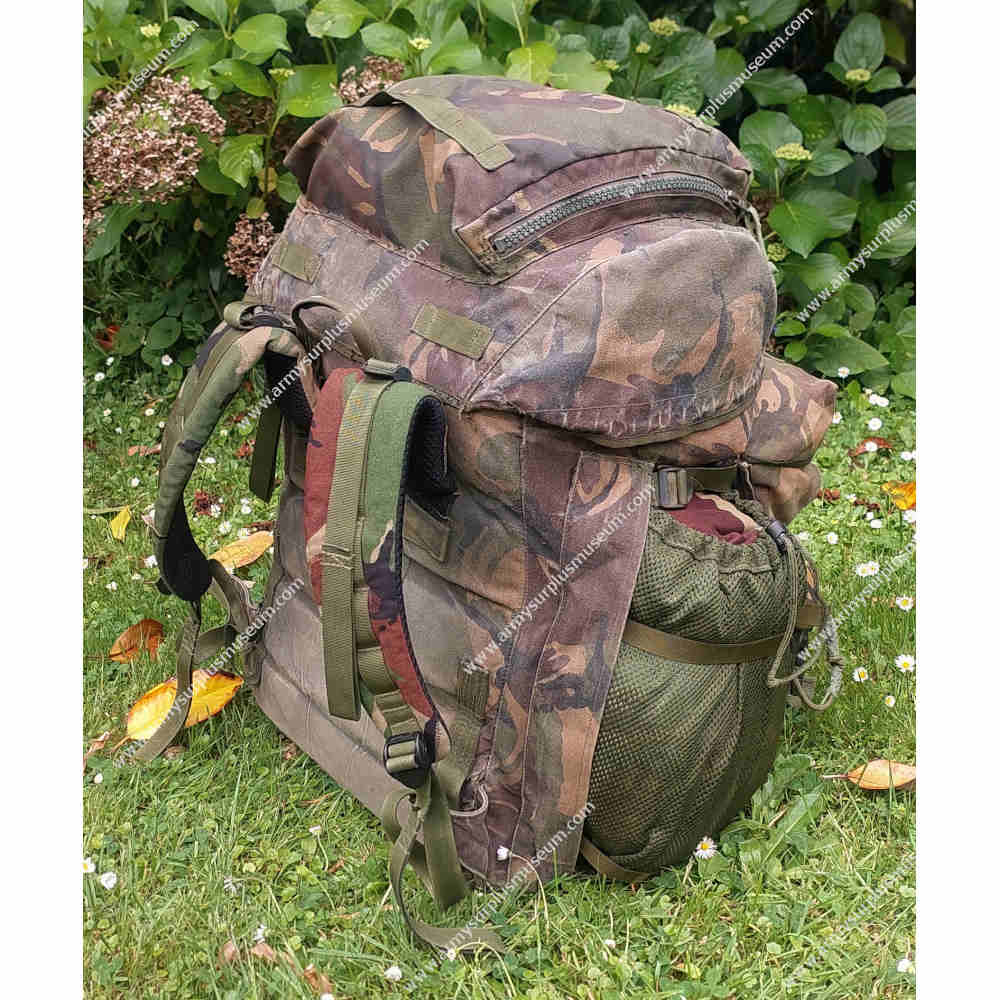
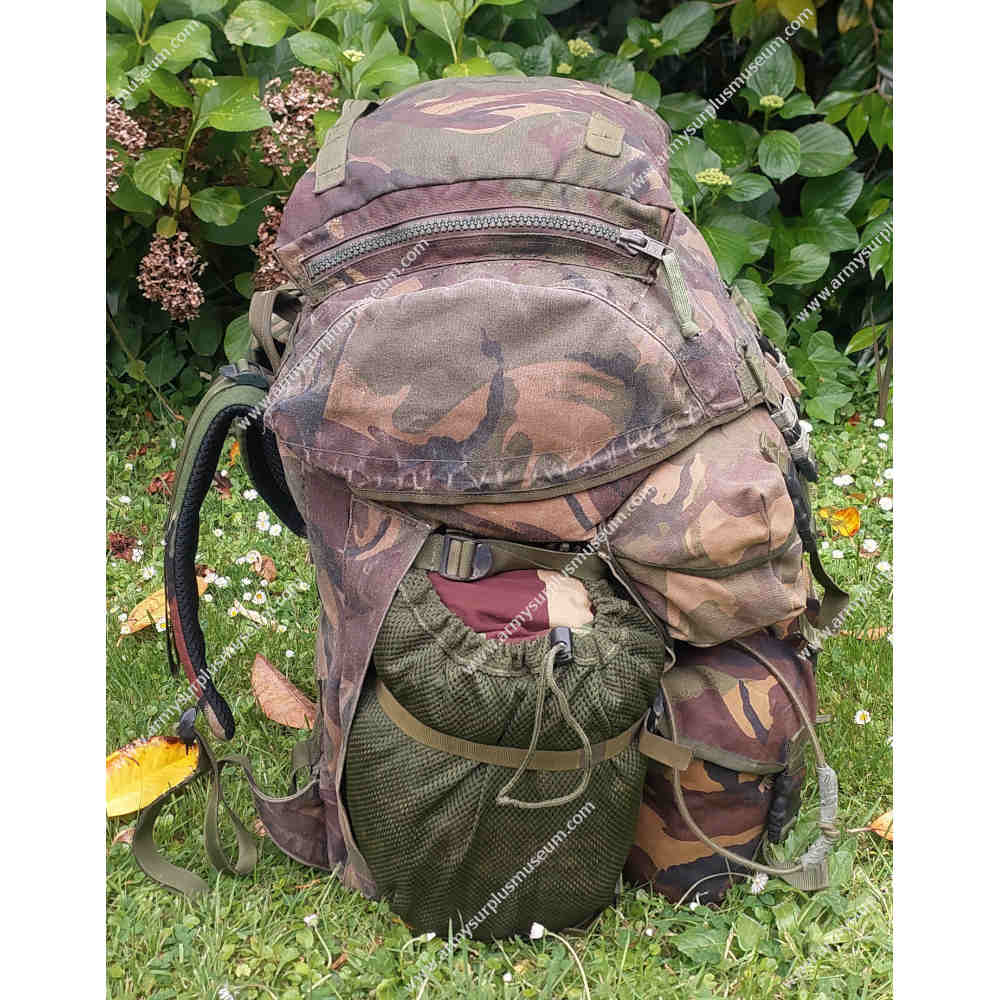
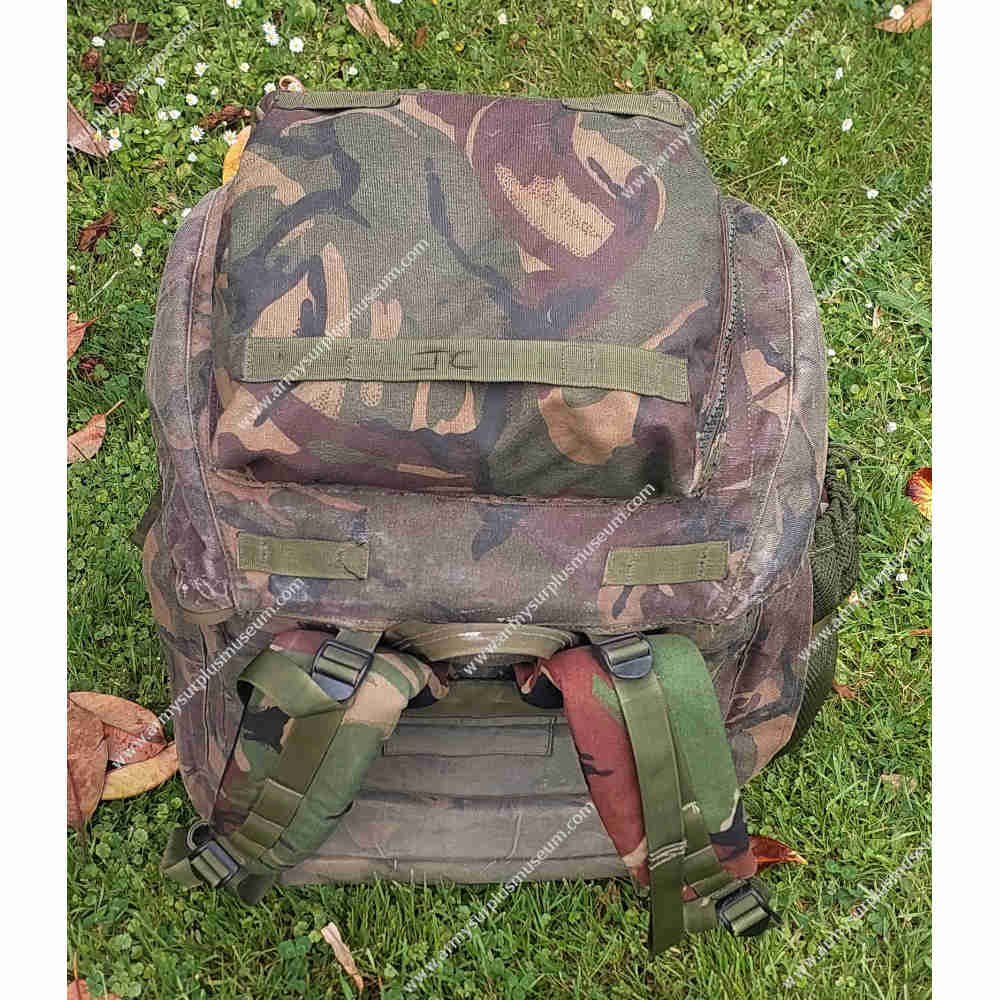
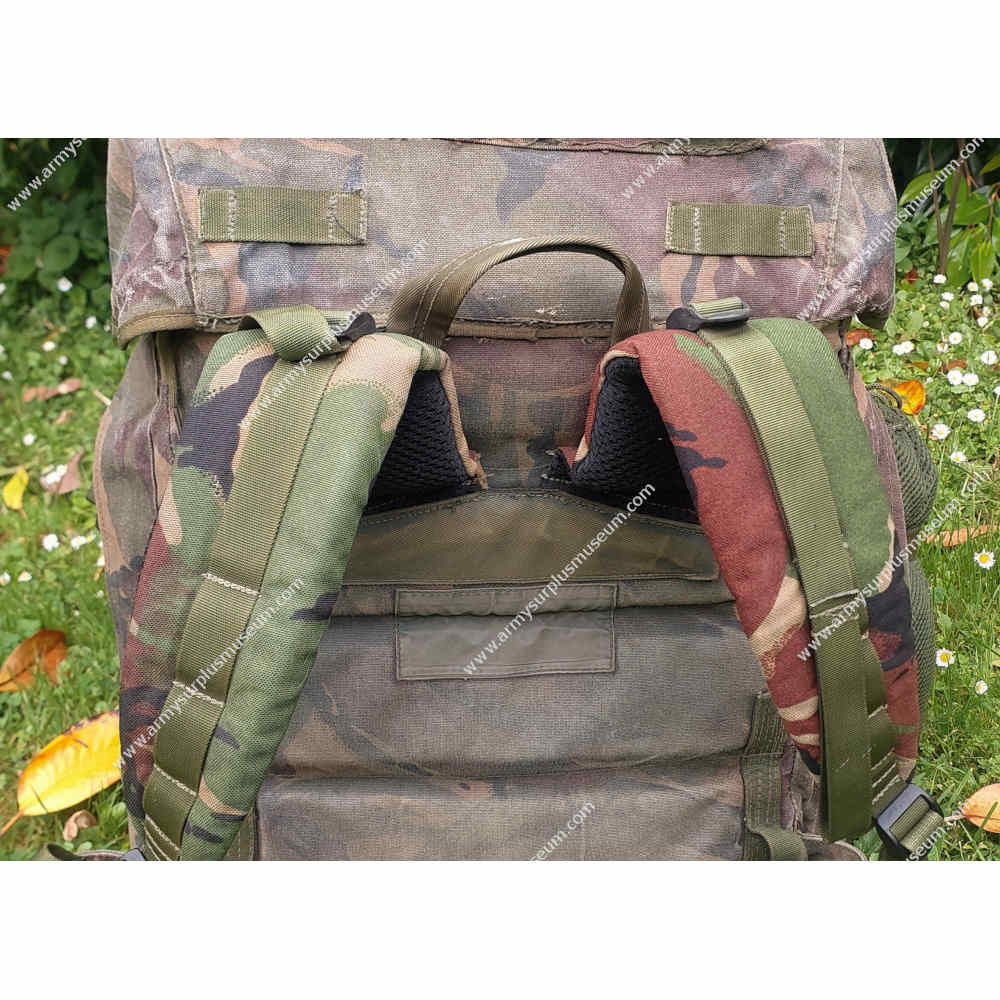
Example three is a short back rucksack produced by an unknown manufacturer in 2005 and extensively modified at a later date by the individual user. The rucksack has been rebuilt with a new set of shoulder straps that are wider and flatter than the originals, designed to distribute weight more evenly across the wearer’s shoulders. In addition, both the internal and external pouch layout have been completely revised, making the rucksack easier to live out of and allowing for improved organization of its contents and admin (personal kit and daily-use items).
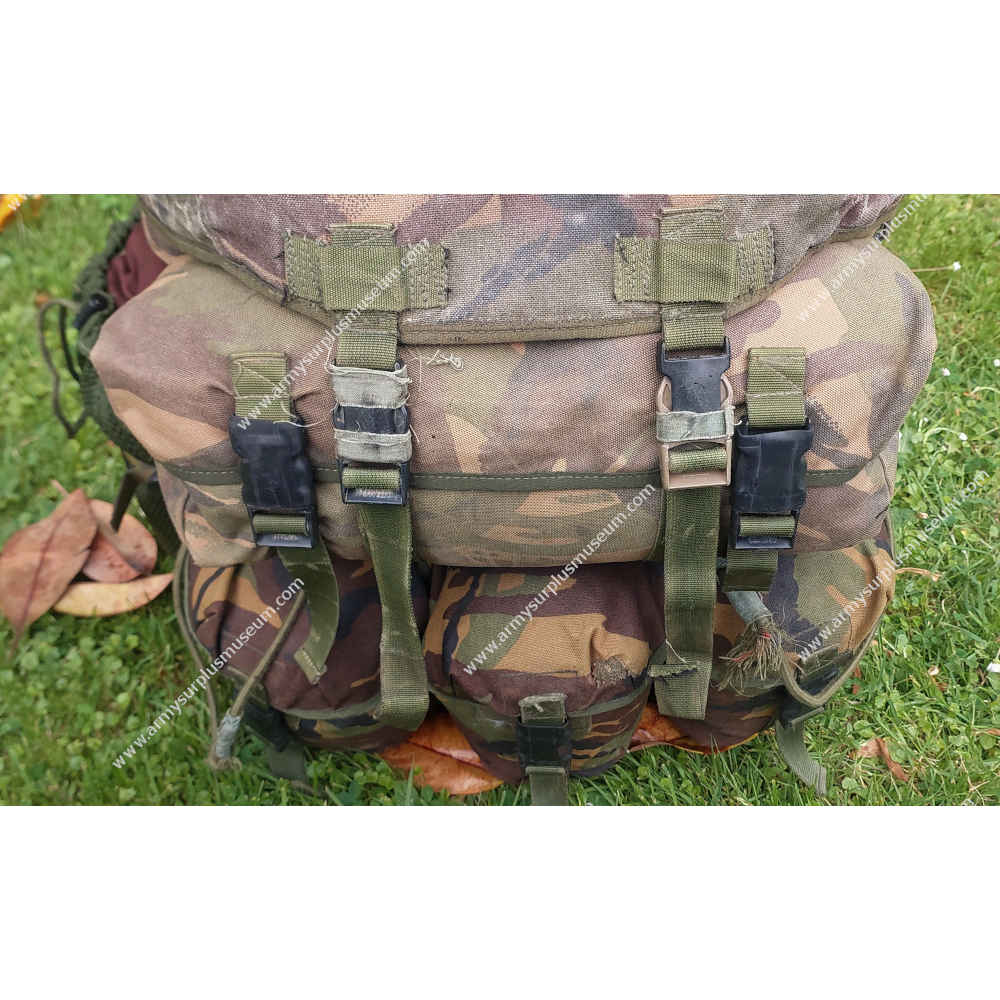
On the right-hand side, a flat mesh pocket has been added between the zip sections, providing additional storage while still allowing a standard side pouch to be attached. The front panel has been completely redesigned, with the upper section now incorporating two elastic shock-cord loops for securing items such as waterproofs. Below these loops is a large square top pocket intended to carry the Shelter, Individual (Basha) and associated components. This pouch closes with a zip and an oversized lid secured by webbing straps and side-release buckles, and closely resembles the front pocket found on the SAS/Para Bergen.
Beneath the lid pouch, three utility pouches Dixies Corner have been permanently sewn onto the front, forming a layered storage system.
To reduce noise during field use, sections of rubber bicycle inner-tube have been fitted to the side-release buckles on the rucksack.
As with many soldier-modified examples, the waist belt has been removed, as it is not used and only adds unnecessary bulk.





NATO Stock Number (NSN): See above.
Contract Number: DC1aESL/0156.
Camouflage Pattern: Temperature Disruptive Pattern (DPM).
Number Of compartments: Seven.
Volume Capacity: 130L.
Top lid compartment- 8L.
Internal. flat lid compartment- 0L.
Main compartment- 90L.
Front, top pouch- 10L.
Front pouches- 4L each.
Mesh pouch- 10L.
Weight: 3.6kg.
Dimensions (cm): 45cm (H) × 36cm (W) × 21cm (D).
Object Number: 3124-826-45105.
Example Four
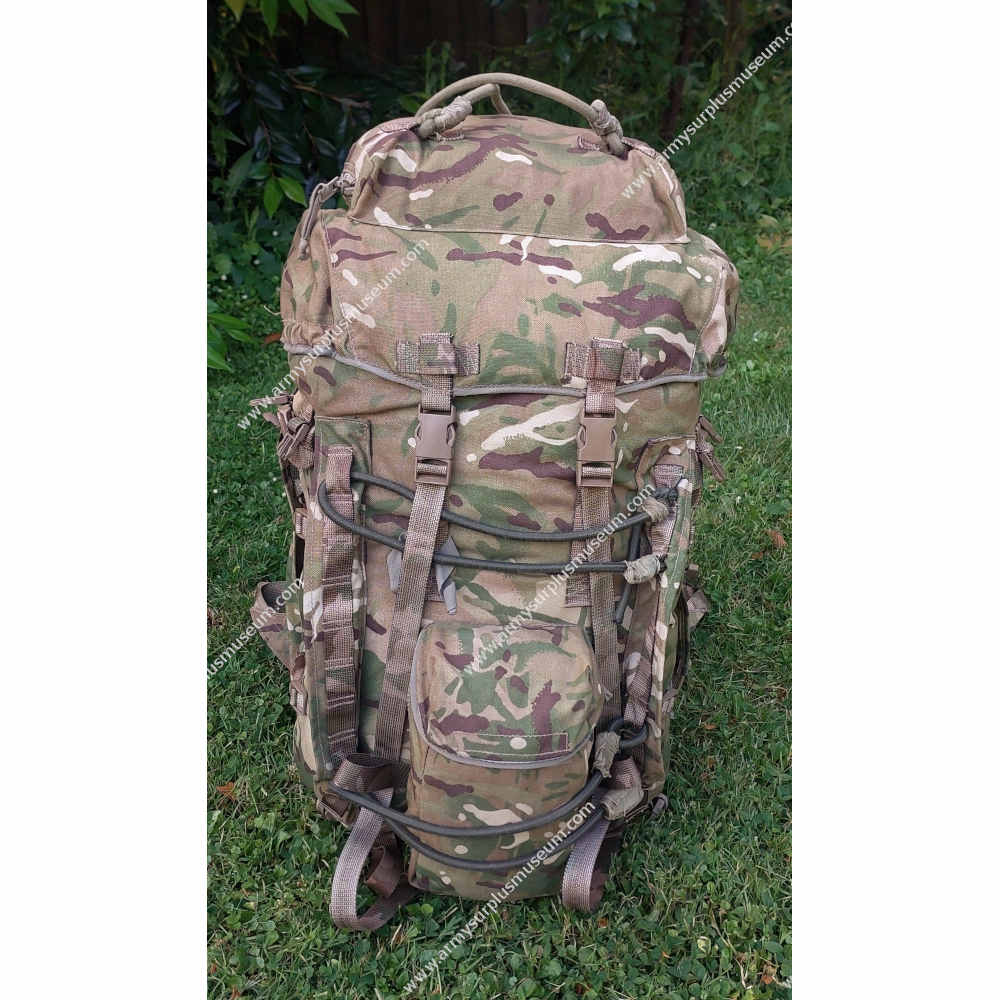
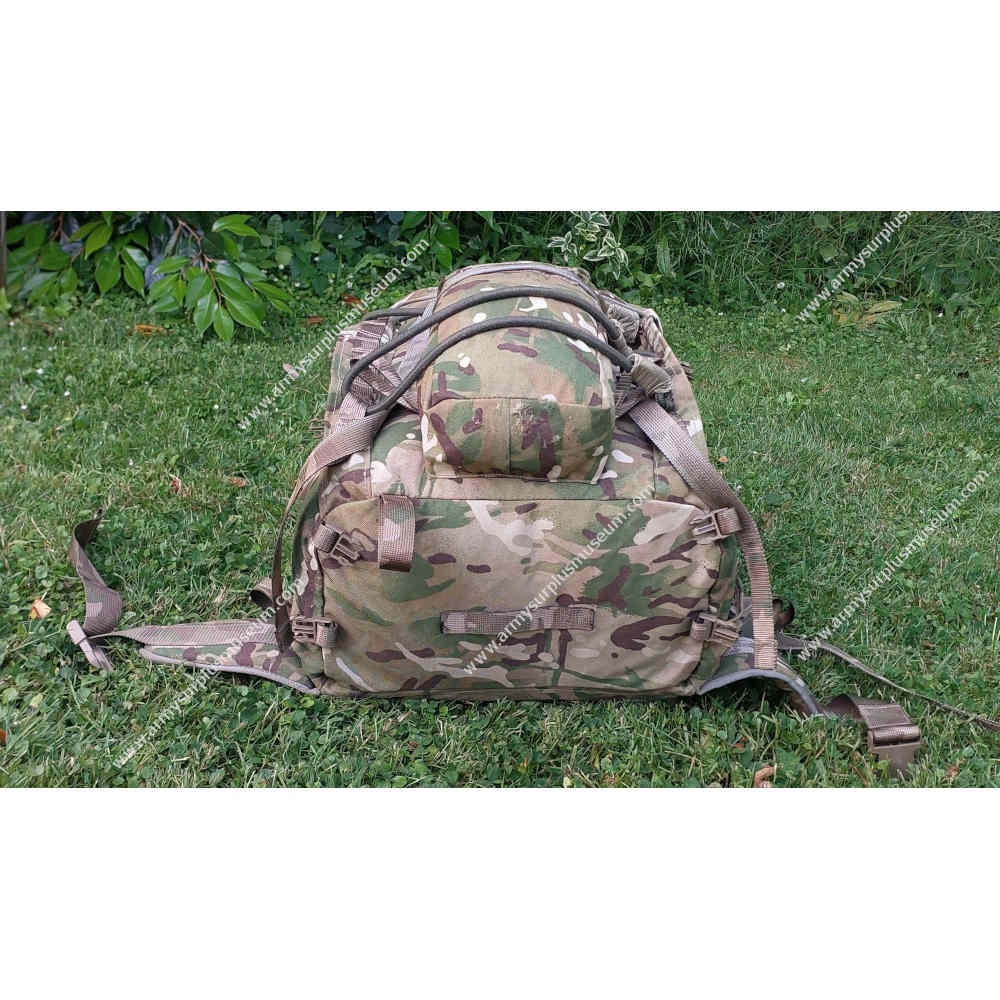
With the United Kingdom’s adoption of the Multi Terrain Pattern (MTP) camouflage, the 90 Pattern Rucksack continued in production in essentially the same design, now manufactured in the new camouflage scheme.
The example shown below was produced in 2014 by an unidentified manufacturer and has been modified with the addition of bungee cords fitted to the top and front of the rucksack. These additions suggest a requirement to externally carry items such as a sleeping mat, which were otherwise awkward to secure using the standard configuration.
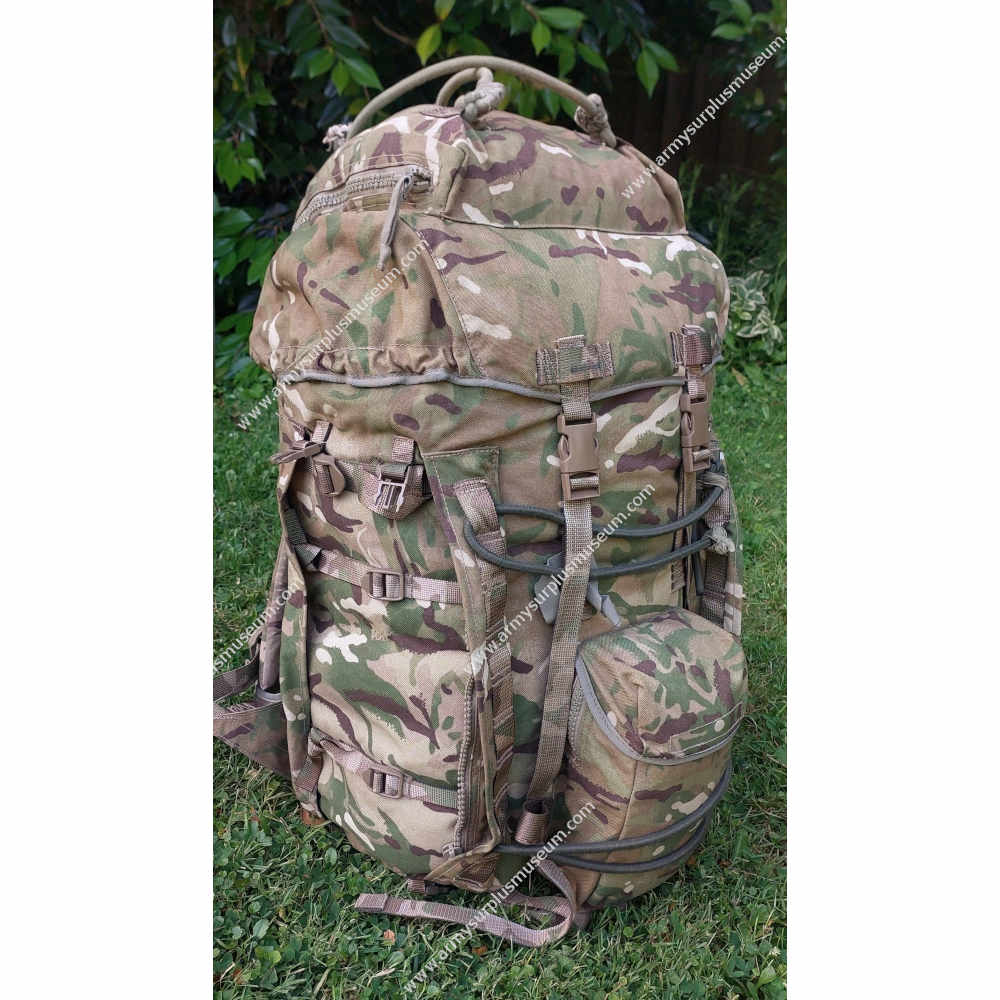
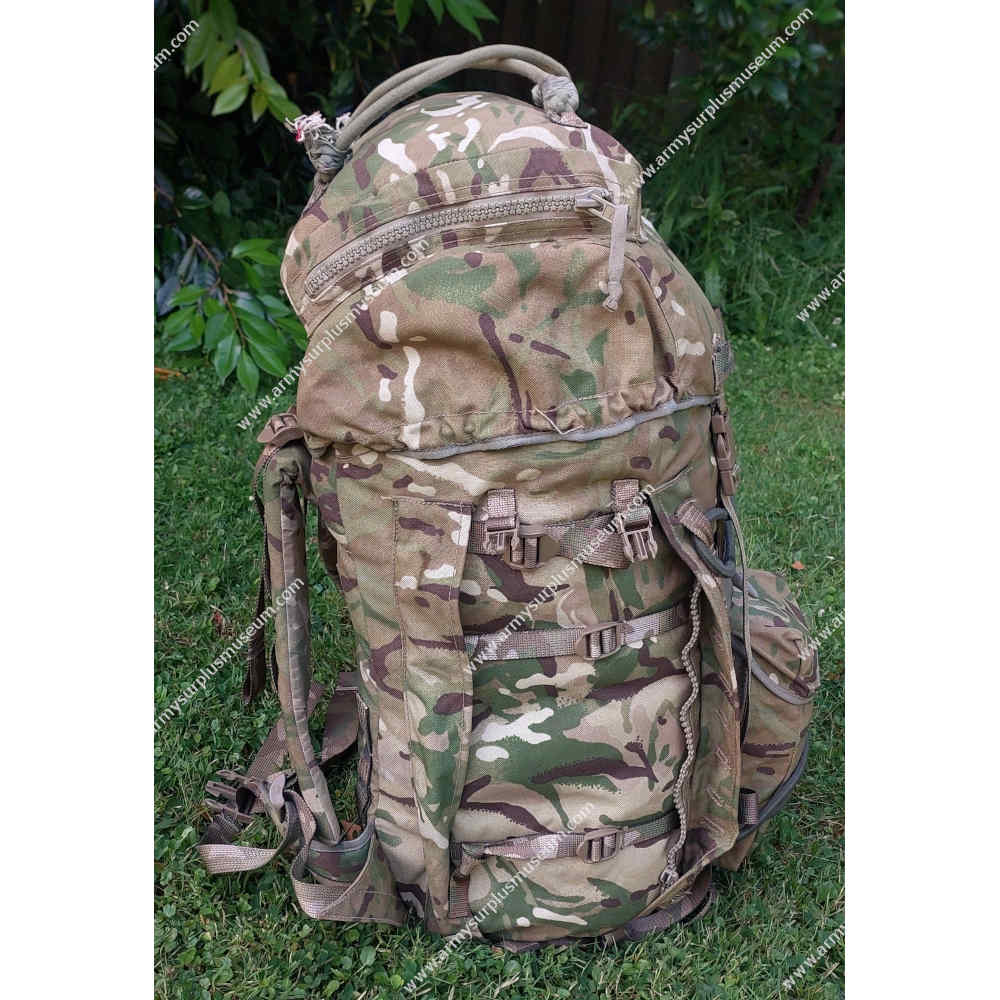
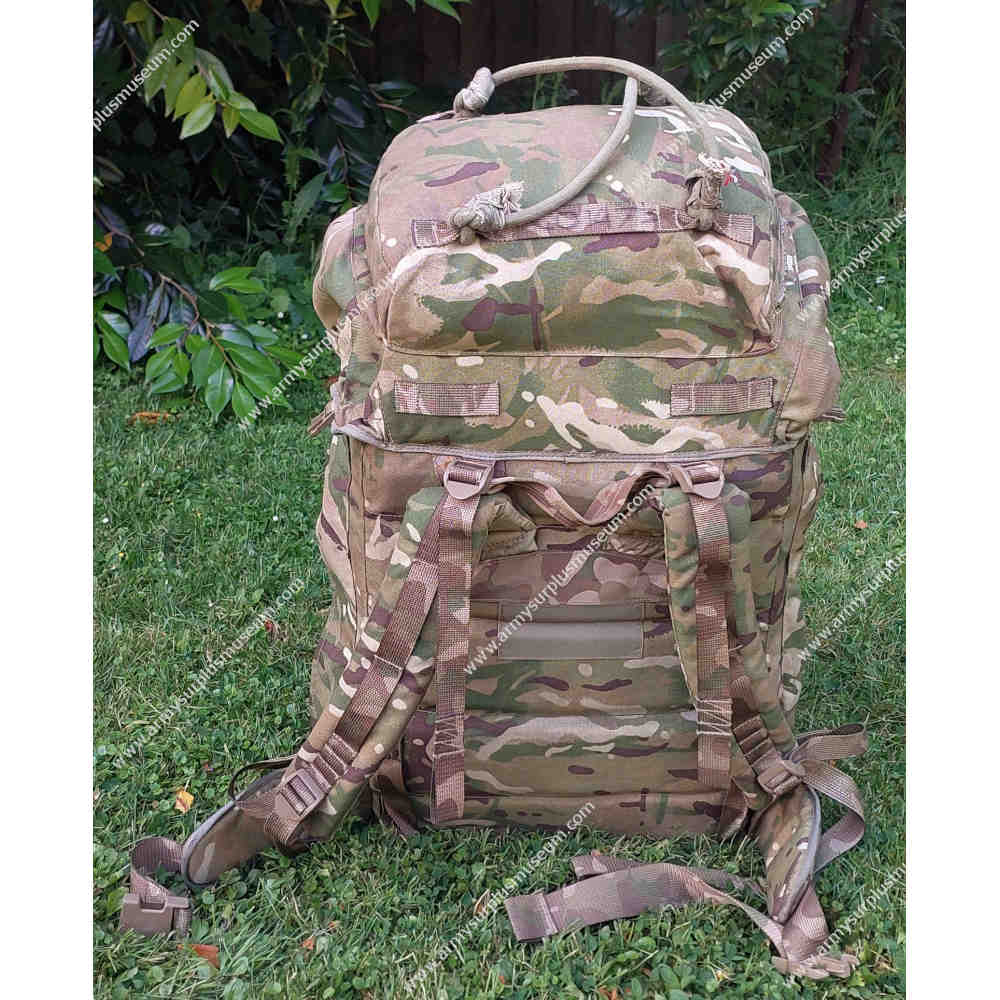

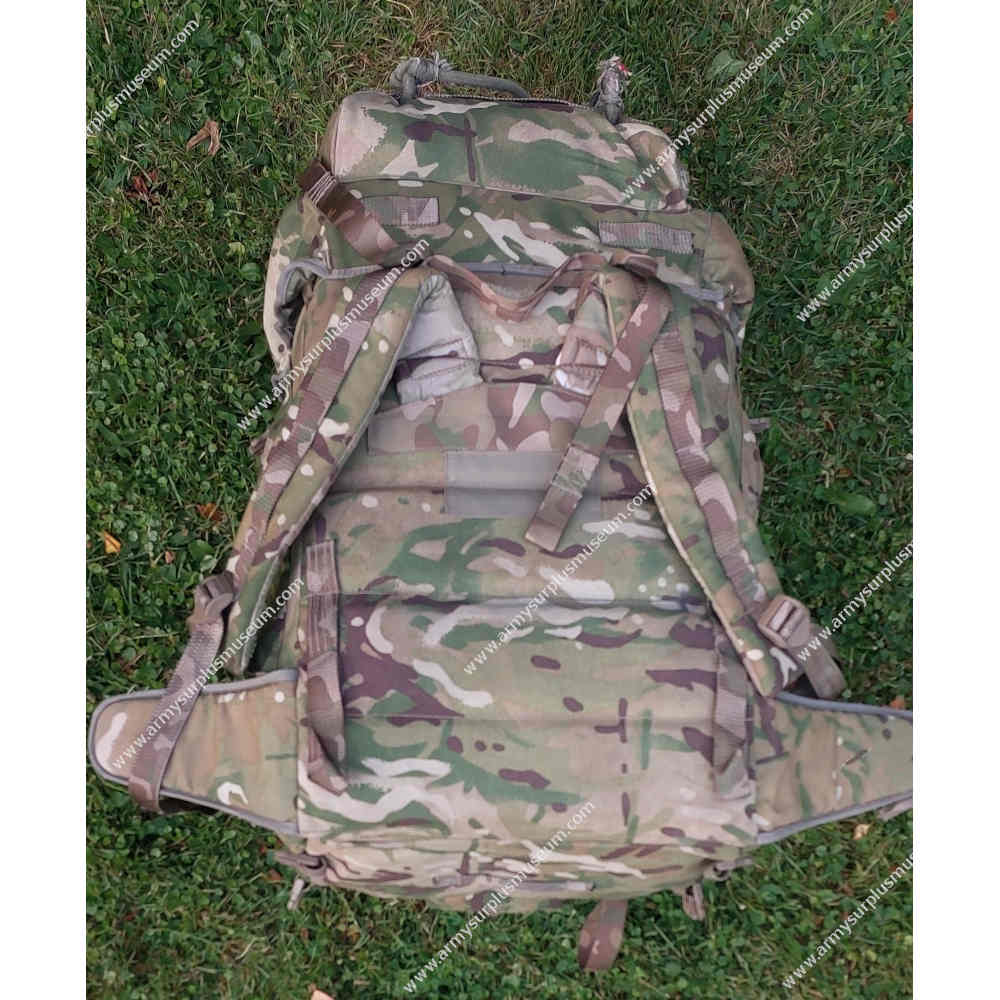
NATO Stock Number (NSN):
Rucksack, Infantry (Inf), Short Convoluted Back, MTP, IRR- 8465-99-551-7438.
Rucksack, Infantry (Inf), Long Convoluted Back, MTP, IRR- 8465-99-361-7307.
Contract Number: PCE/00037.
Camouflage Pattern: Multi Terrain Pattern (MTP).
Number Of compartments: Four.
Volume Capacity:
Top lid compartment- 8L
Internal, flat lid compartment- 0L
Main compartment- 90L
External compartment- 5L
Weight: 2.7kg.
Dimensions (cm): 45cm (H) × 36cm (W) × 21cm (D).
Object Number: 3124-826-45106.
