
Jäger Rucksack (Hunters Rucksack)
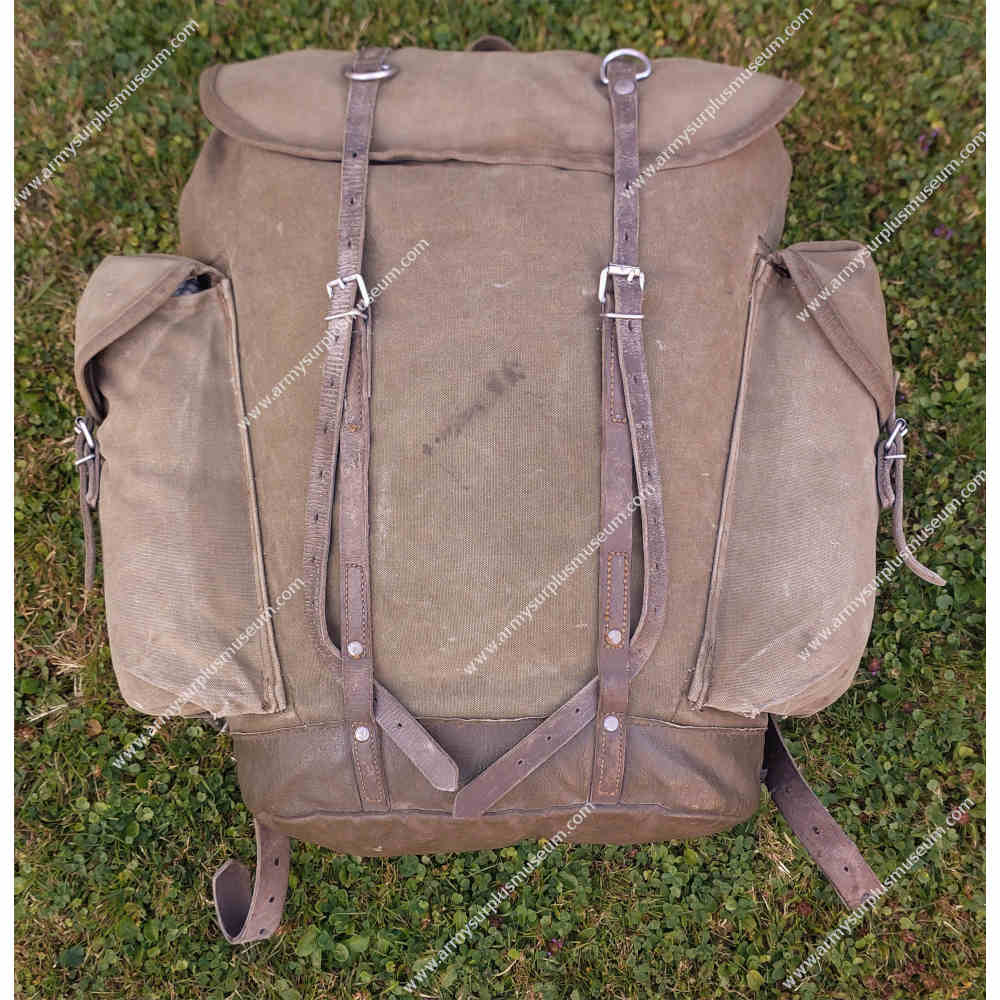
General Information
Name: Jäger Rucksack (Hunters Rucksack).
Country of Origin: West Germany.
Date of Production: Circa 1985.
Manufacturer: Yet to be determined.
NATO Stock Number (NSN): 8465-12-138-9329.
Colour: Field Grey.
Equipment Family: Yet to be determined.
Number Of compartments: Four.
Volume Capacity: 35lts.
Weight: 1.2kg.
Waterproof: Partly.
History
The Jäger Rucksack was first introduced by the Bundeswehr in the early 1960s as a more compact alternative to the large rucksack. Unlike its predecessor, it could be worn independently of the web suspenders and frame, reducing bulk while still offering enough capacity for extended periods in the field. The design quickly gained popularity with troops, who found it practical for carrying essential kit while strapping bulkier items such as the sleeping bag, parka, or NBC suit to the outside. The side pockets were tunnel-stitched to allow skis to be carried when required, reflecting its versatility.
Originally produced in canvas with leather straps and metal fittings, the pack was later updated as Bundeswehr load-bearing equipment modernized. Around 2000, production shifted to stone-grey textured nylon with nylon straps and plastic buckles, aligning the pack with the new webbing system then being adopted across the army.
The pack carried a prescribed set of items. In the main compartment soldiers carried the sleeping mat in its sleeve, thermal clothing, half shelter, field rations, a sweater, poncho, handkerchiefs, towel, and washing kit. The side pouches typically held spare G3 20-round magazines, socks, a sewing kit, and a shoe-shine kit. Bulkier items such as the sleeping bag or parka were strapped to the top lid, while the NBC suit was usually secured to the outside. Any remaining space could be filled with personal kit, giving each soldier the flexibility to adapt the pack to individual needs while still maintaining standard issue.
Description
The field pack is a medium-sized rucksack closed by a large, flat, unshaped lid secured with two straps and buckles that run down the front of the pack. These straps are sewn with horizontal loops further down, allowing additional equipment to be attached. On the outer surface of the lid are two sets of D-rings for securing items with straps, while the underside is lined with a rubberized, laminated fabric to provide waterproofing.
The pack is carried on wide, adjustable shoulder straps sewn to the top and reinforced with a webbing section. At the base of the back are vertical loops on either side, designed to take a 1-inch webbing strap for use as a waist belt. In later production versions, this strap was threaded through ladder-lock buckles fitted just below the shoulder straps.
The base of the pack is reinforced for durability. Early models used heavy-duty vinyl fabric with a rubberized finish, while later examples relied on a second layer of nylon fabric for reinforcement. The mouth of the main compartment closes with a drawcord. Against the back wall inside is an open-top sleeve designed to hold the Bundeswehr fold-up groundsheet, secured in place with two short webbing straps.
On each side of the pack is an external pouch with a lid that fully covers the opening, secured with straps and buckles. These pouches are sewn to the body of the pack in such a way that they form vertical tunnels between pouch and pack, allowing skis to be carried securely when required.
Examples
Example One


Volume Capacity:
Main compartment- 30L.
Sides pouches- 2.5L.
Object Number: 3120-2761-45100.
